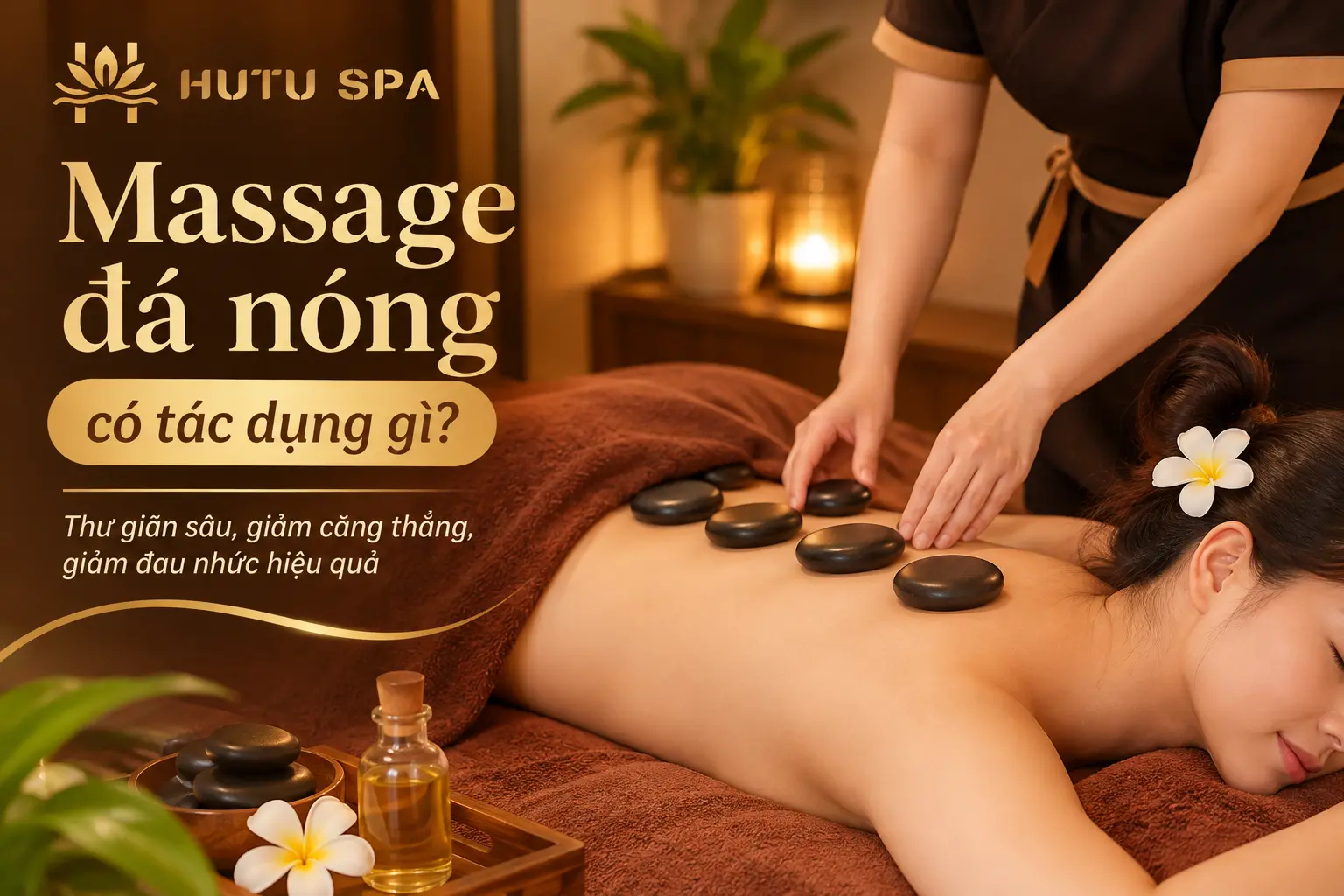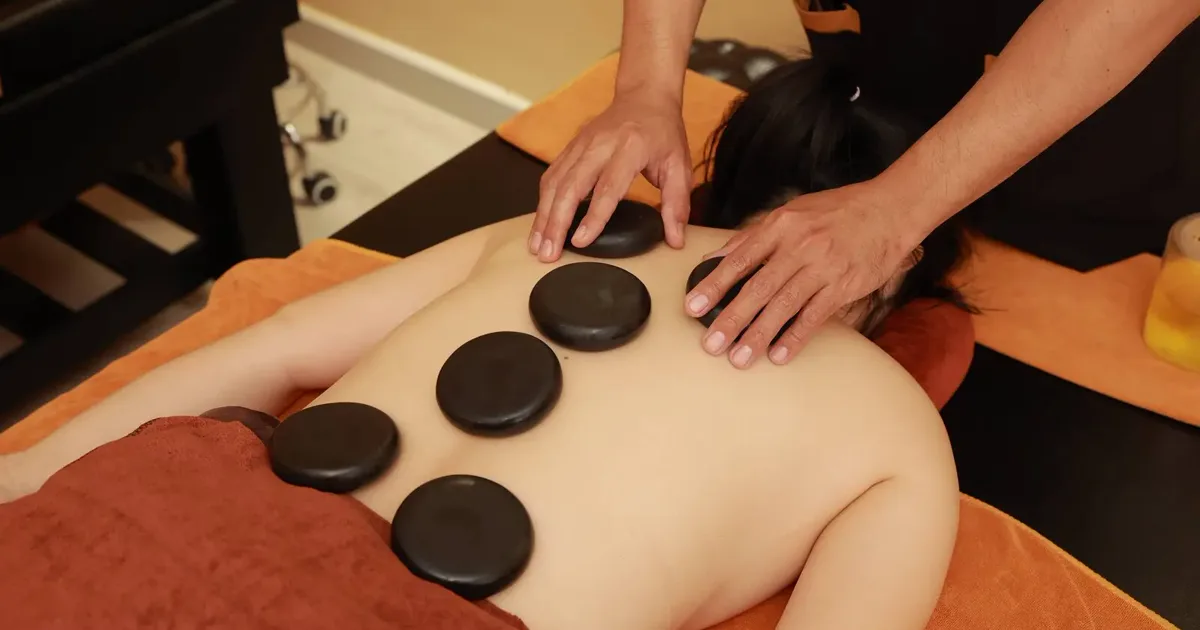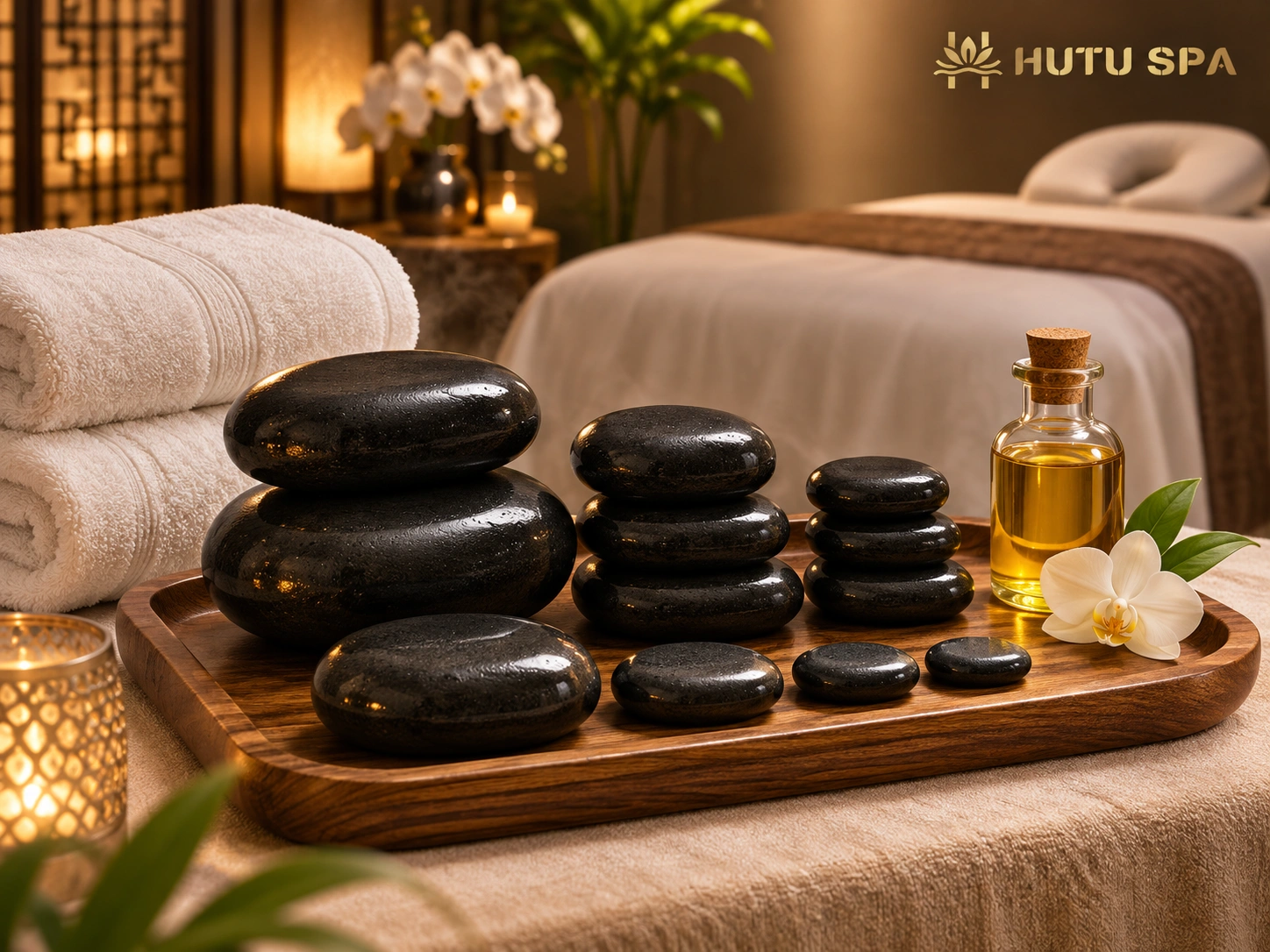
Basalt massage stones are black or dark grey volcanic stones, polished smooth into round or oval shapes, that are heated and then placed on or glided over the body during hot stone massage. Spas choose basalt because it is dense and fine-grained, holds heat for a long time and releases it slowly, so the warmth sinks into the muscles evenly and comfortably instead of feeling scorching for a few seconds and then cooling right away.
This article explains how basalt forms, why it became the industry standard for spas, what temperature is safe, how to tell genuine stones from poor-quality ones, and which "healing hot stone" claims you should not believe. It was compiled by the Hutu Spa Editorial Team from geological sources, guidance from international massage organisations and our experience running hot stone treatments in Nha Trang.
Quick summary:
- Basalt is an extrusive igneous rock that forms when lava rich in iron and magnesium cools quickly at the Earth's surface.
- Its density is about 2.9 g/cm³, higher than granite, so a basalt stone of the same size can hold more heat.
- Its low thermal conductivity (around 1.96 W/m·K on average) lets the stone release heat gradually onto the skin.
- The water used to heat the stones is usually about 43 to 54°C. The figure "130 to 145 degrees" often seen online is in Fahrenheit, not Celsius.
- Basalt stones help you relax and soften the muscles, but they do not cure disease and do not "draw out toxins".
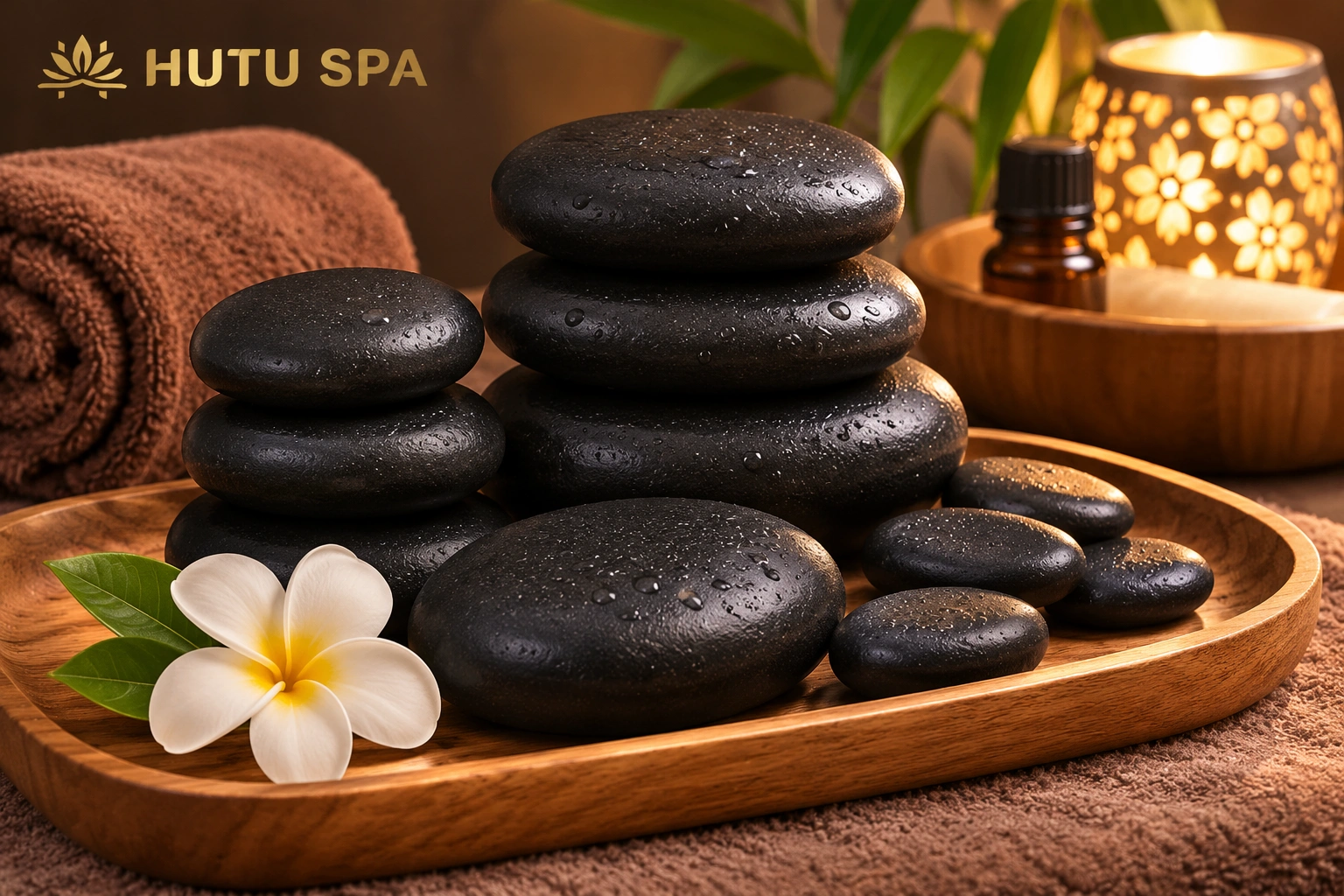
What are basalt massage stones?
Basalt massage stones are natural basalt stones that have been selected and polished for use in hot stone massage. In English they are called basalt stones or simply hot stones. Many spas in Vietnam call them "volcanic massage stones", because basalt is the most common volcanic rock.
How does basalt form?
Geologically, basalt is a fine-grained extrusive igneous rock. It forms when low-viscosity lava rich in iron and magnesium erupts onto the surface and cools quickly. Because it cools so fast, the mineral crystals do not have time to grow, creating a dense, uniform structure. Geologists classify basalt as a "mafic" rock, meaning it is rich in magnesium and iron.
Basalt makes up more than 90% of all volcanic rock on Earth and is the main component of the ocean crust. Because it is so common, the supply of stone for massage is plentiful and reasonably priced.
Composition and identifying features
- Silica content: about 45 to 52% SiO₂, lower than many other rocks.
- Main minerals: calcium-rich plagioclase feldspar and pyroxene (such as augite), sometimes with olivine.
- Colour: dark grey to black, mainly due to pyroxene. When soaked in oil or water, the stone looks glossier and blacker.
- Density: about 2.9 g/cm³, heavier in the hand than granite (about 2.7 g/cm³) of the same size.
- Structure: very fine grain, with crystals almost invisible to the naked eye.
Basalt around us in Vietnam
Vietnamese people know basalt through the red basalt soils of the Central Highlands, where weathered basalt has become the famous coffee-growing land. Visitors to Nha Trang can also see basalt with their own eyes at Ganh Da Dia, where about 10,000 hexagonal basalt columns stand packed together along the shore. This landmark used to belong to Phu Yen Province and is now part of Dak Lak Province after the two provinces merged on 30 June 2025.
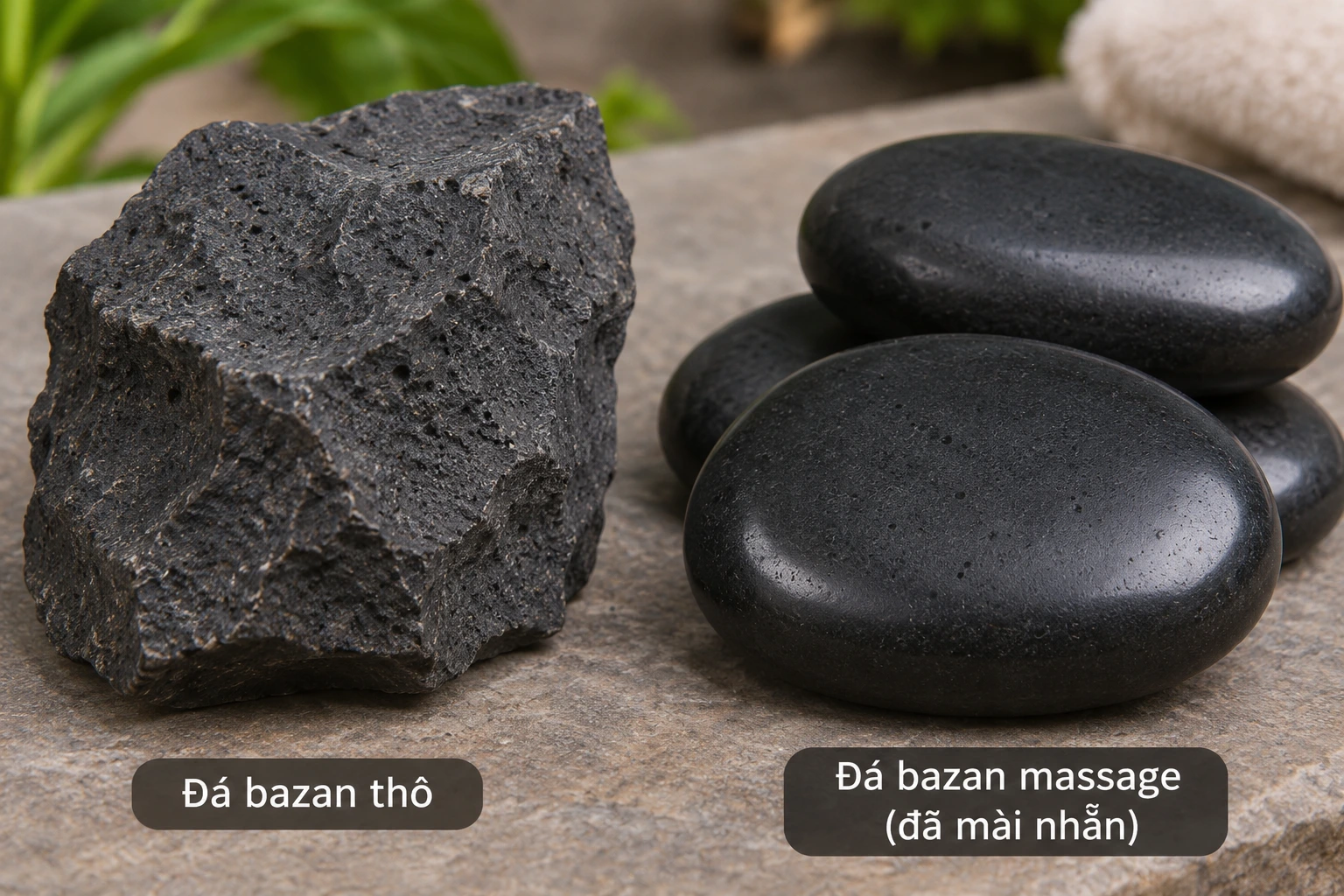
Those columns and the stones on a massage table are the same material. The difference is that massage stones are chosen from dense basalt without pores, then rounded off at the edges to follow the curves of the body.
Why is basalt used in hot stone massage?
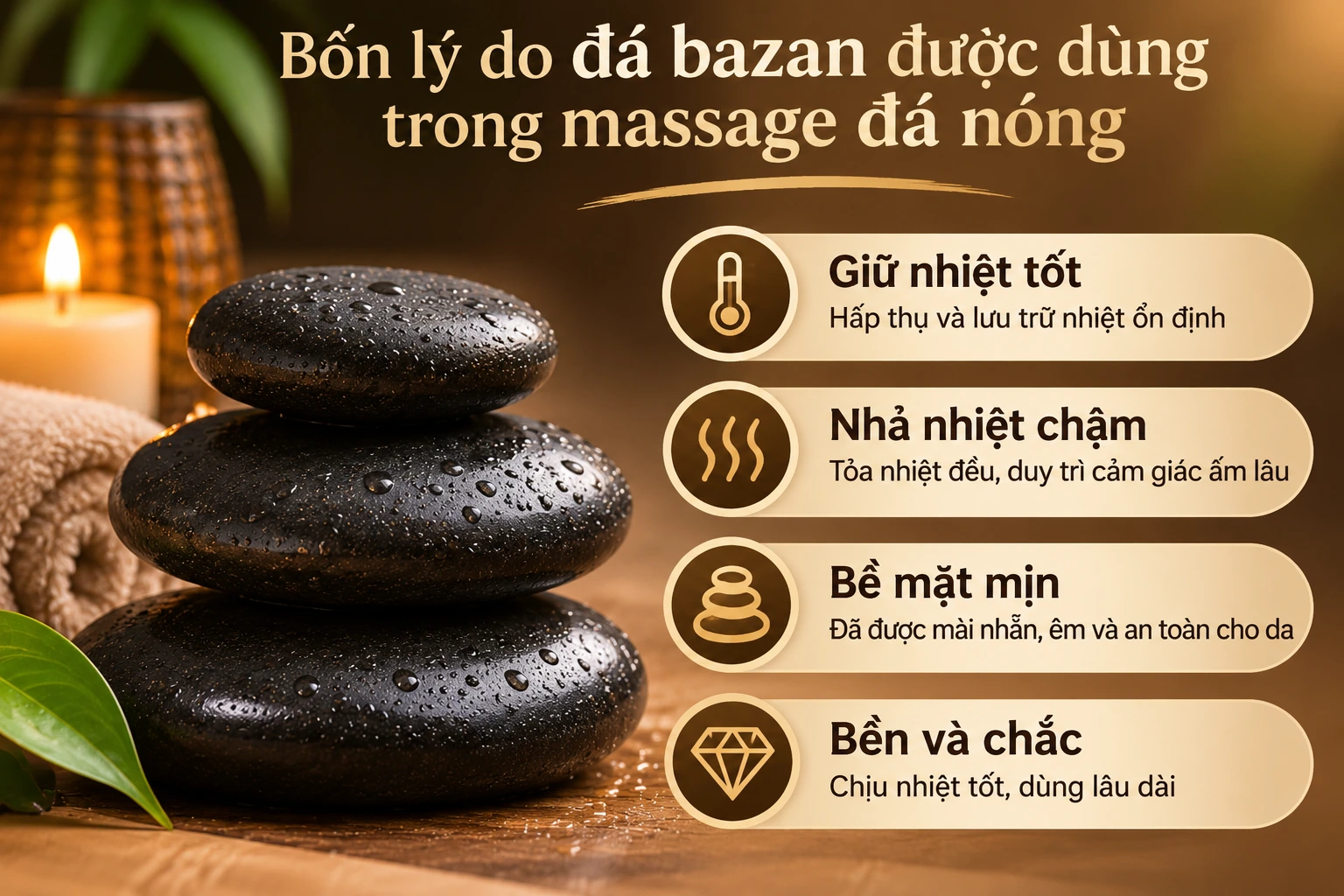
Basalt is used in hot stone massage because it meets four conditions that few other stones meet together: it holds a lot of heat, releases heat slowly, has a smooth surface and withstands repeated soaking in hot water every day. Popular medical sources such as WebMD and Healthline describe hot massage stones as basalt, a volcanic rock that is often rich in iron and therefore absorbs heat well.
Long heat retention thanks to high density
How much heat a stone can store depends on its mass. Basalt has a density of about 2.9 g/cm³, so a palm-sized stone is already heavy enough to "store" a significant amount of heat. In practice, a large basalt stone placed on the back (over a towel) stays warm for many minutes, long enough for the back muscles to gradually let go.
Slow, even heat release thanks to low thermal conductivity
A dataset from the Geological Survey of Canada shows that the average thermal conductivity of basalt is about 1.96 W/m·K, the lowest among the crystalline rocks surveyed (the highest was about 3.50 W/m·K). Low thermal conductivity means heat travels from the inside of the stone to its surface gradually. The skin feels a soft, steady warmth rather than the sudden sting you get from touching metal at the same temperature.
This is why first-timers often find the first stone a little hot for a few seconds, after which it mellows into a deep warmth. The principle is similar to a warm compress at home, except that the heat is combined with massage strokes. If you are unsure when to use heat and when to use cold on your muscles, our article on hot or cold compresses explains the difference clearly.
Smooth, low-absorbency surface that is easy to clean
Basalt's mineral grains are very small, so once polished the stone feels silky smooth. It glides over the massage oil without pulling the skin. Dense basalt also has few pores, so it absorbs little oil and is easy to clean between guests, an important point for spa hygiene.
Resistant to heat and water
The American Massage Therapy Association (AMTA) considers heating stones in water the only acceptable method. Massage stones therefore have to withstand soaking in hot water every day. Basalt handles this well, whereas Himalayan salt stones, for example, slowly dissolve when soaked.
Affordable and easy to shape
Basalt is abundant and easy to cut and polish into many sizes: large stones for the back and thighs, medium stones for the shoulders and calves, and small stones to tuck between the toes. Spas can replace stones when needed without the cost of precious stones.
The history of hot stone therapy and the role of basalt
Using warm stones to heat and rub the body is a very old practice, but basalt hot stone massage in the style of the modern spa only became popular in the 1990s.
Ancient traces
Some sources suggest that using stones in body care may go back to India's Ayurvedic medicine around 5,000 years ago. In China, about 2,000 years ago, people used heated stones in the belief that they helped regulate the internal organs. Communities in North America, Hawaii, Japan and many South Pacific islands also had similar ways of using warm stones in healing or rituals.
Note that most of these accounts are traditional, and it is hard to verify exactly which stones were used or how. They show that people have long recognised the pleasant warmth of stones, not that stones have healing powers.
Mary Nelson and LaStone Therapy in 1993
The turning point came in 1993, when American massage therapist Mary D. Nelson developed a method alternating hot and cold stones and named it LaStone Therapy. The method was a commercial success and became the foundation for many of today's hot stone massage variations.
In LaStone and the methods that followed, basalt plays the role of the "hot stone", while marble usually takes the role of the "cold stone". This division comes from the thermal properties of the two stones, compared in detail later in this article.
From river stones to quarried basalt
At first, massage stones were mostly basalt pebbles rounded naturally by rivers or ocean waves. As demand grew, manufacturers switched to cutting basalt from inland quarries and polishing it into the desired shapes. MASSAGE Magazine has featured this trend of quarried basalt stones as a new step forward for the industry. As a result, spas can buy complete sets of stones that are uniform in size, thickness and smoothness, which helps therapists control heat better.
Benefits of basalt hot stone massage and the strength of the evidence
The clearest benefit of basalt hot stone massage is that it softens the muscles faster and relaxes the body more deeply than hands-only massage. The warmth from the stones dilates local blood vessels, increases blood flow to the muscles and helps the therapist work on tight fibres without pressing too hard.
Commonly reported benefits
- Less muscle tension and stiffness: heat has long been used to ease spasms and improve flexibility, especially in the back, neck, shoulders and calves.
- Less stress: a 1997 study (Cady and Jones) found that a 15-minute chair massage at work reduced stress more than a 15-minute break without massage.
- Better sleep: one review suggests back massage may be a supportive option for people who sleep poorly. Many guests also report a pleasant drowsiness after a hot stone session.
- Less discomfort for people with fibromyalgia: a 2002 study (Field and colleagues) found that people who received 30-minute massages slept longer and had fewer tender points than a group that only did relaxation exercises.
- Comfort on cold days or after a long day: for travellers who have walked a lot or sat in a vehicle for hours, the warmth of the stones helps them unwind very quickly.
Most of the studies above looked at massage in general, not hot stone massage specifically. You can read an analysis of each benefit and its level of evidence in our article what does hot stone massage do to set the right expectations.
What basalt stones cannot do
On online marketplaces it is easy to find claims that hot stones "store the energy of heaven and earth", "draw out toxins", "cure spinal degeneration" or "prevent stroke". These claims have no scientific basis.
High-quality systematic reviews only report modest short-term benefits from massage in general, and there are no high-quality long-term studies specifically on stone massage. Basalt also does not "release" minerals or ions into the body through the skin. Its role is purely that of a good heat conductor and a massage tool of the right weight.
Understanding this lets you enjoy hot stone massage as a relaxing, restorative experience, not as a substitute for medical treatment when you have a health condition.
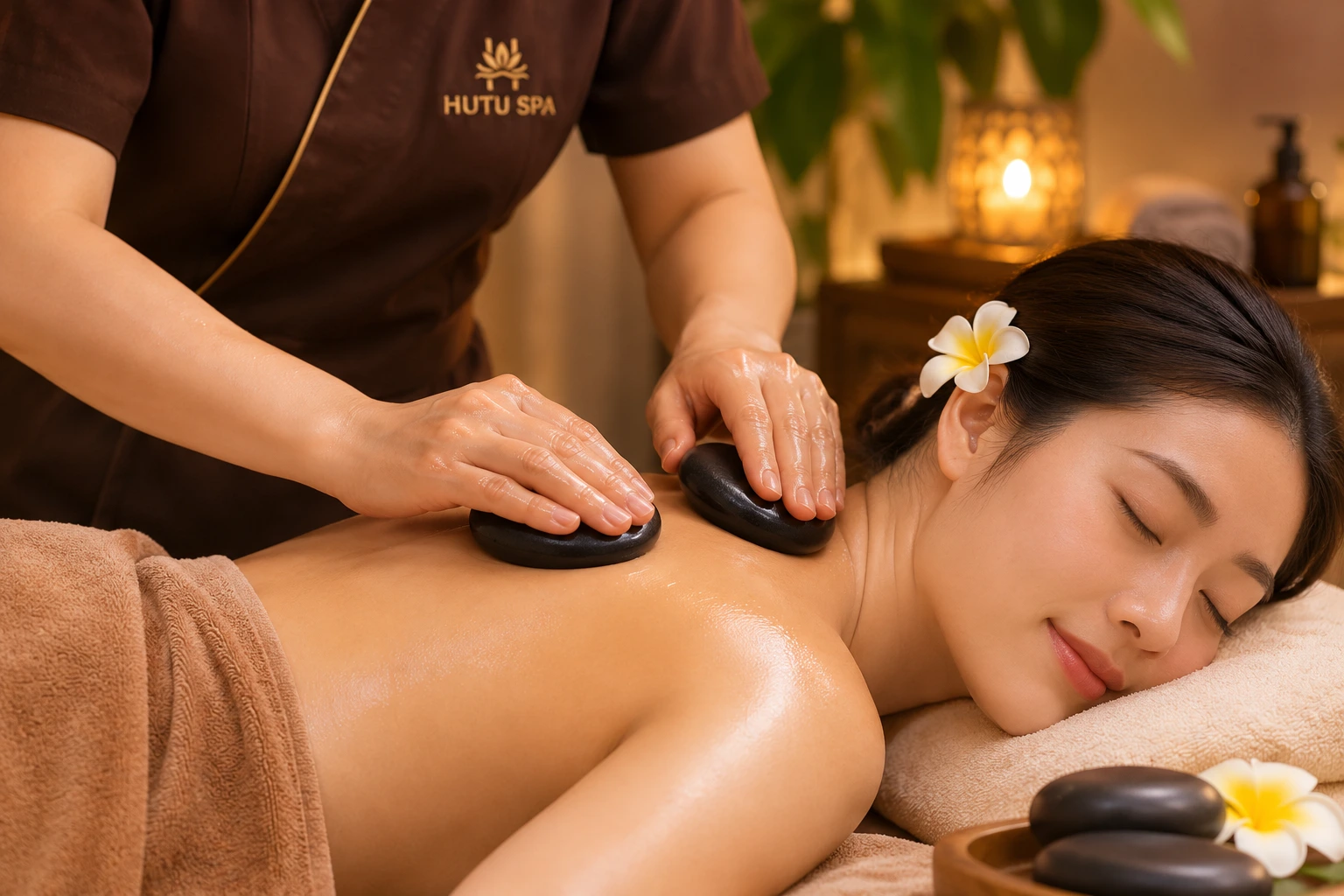
Basalt compared with other massage stones
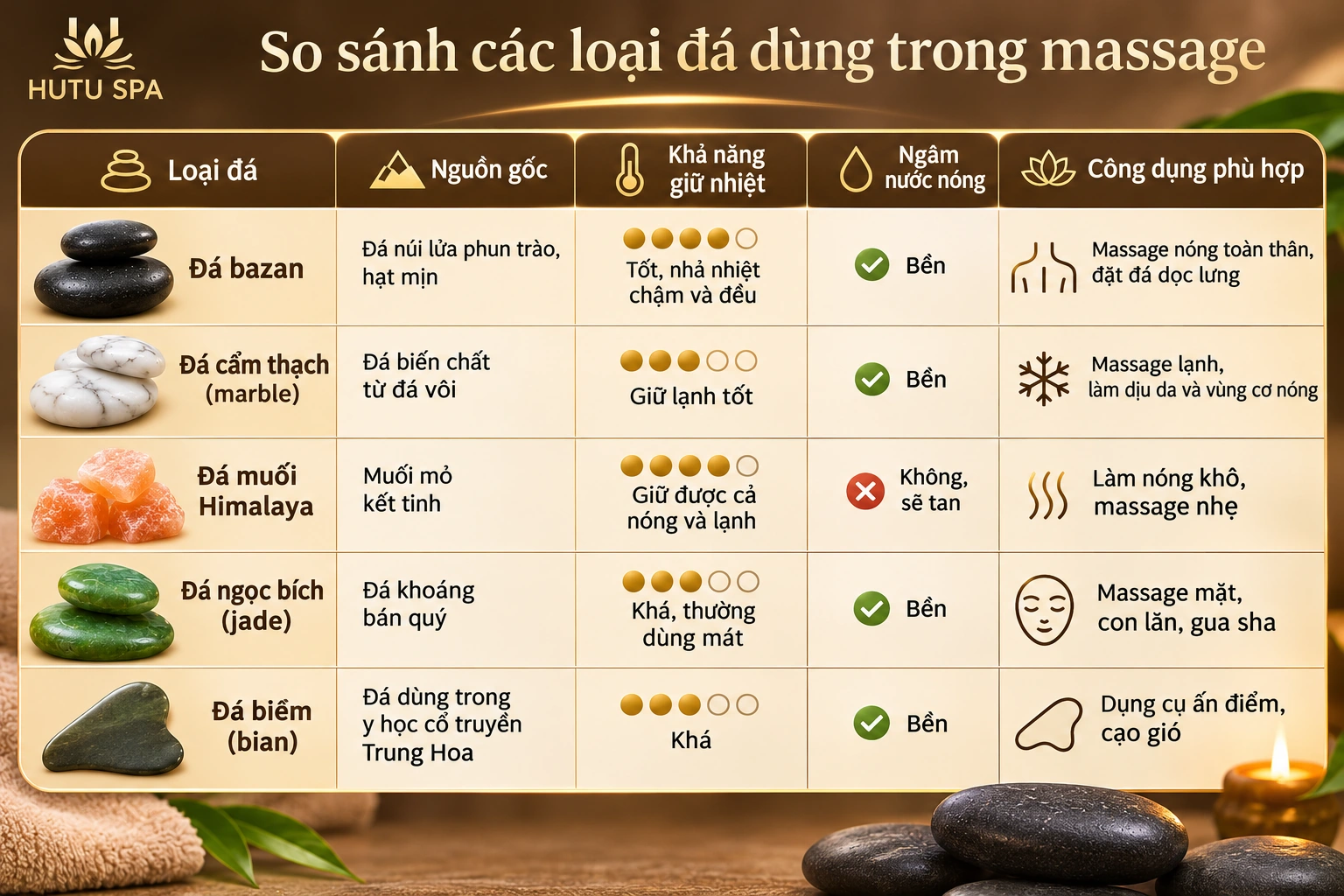
Among common massage stones, basalt is the most balanced choice for full-body hot massage, while marble is better suited to cold massage. The table below sums up the differences so you can see why spas prefer basalt for hot stone treatments.
| Stone | Origin | Heat retention | Soaking in hot water | Best use |
|---|---|---|---|---|
| Basalt | Extrusive volcanic rock, fine-grained | Good, releases heat slowly and evenly | Durable | Full-body hot massage, stones placed along the back |
| Marble | Metamorphic rock formed from limestone | Holds cold well | Durable | Cold massage, soothing the skin and warm muscles |
| Himalayan salt | Crystallised rock salt | Holds both heat and cold | No, it dissolves | Dry heating, light massage |
| Jade | Semi-precious mineral stone | Fair, usually used cool | Durable | Facial massage, rollers, gua sha |
| Bian stone | Stone used in traditional Chinese medicine | Fair | Durable | Acupressure tools, scraping |
One little-known point: not every volcanic stone can be used for massage. Pumice, porous basalt and the lava beads used in bracelets contain many air bubbles. They are light, hold heat poorly, absorb oil and are hard to clean, so they are not suitable for placing on the skin.
The reason marble is usually kept for the "cold stone" role is easy to understand. When chilled, it stays cool for a long time and its light colour makes it easy to tell apart from black basalt in the same session. Some treatments alternate the two stones to create a refreshing feeling after the warm phase.
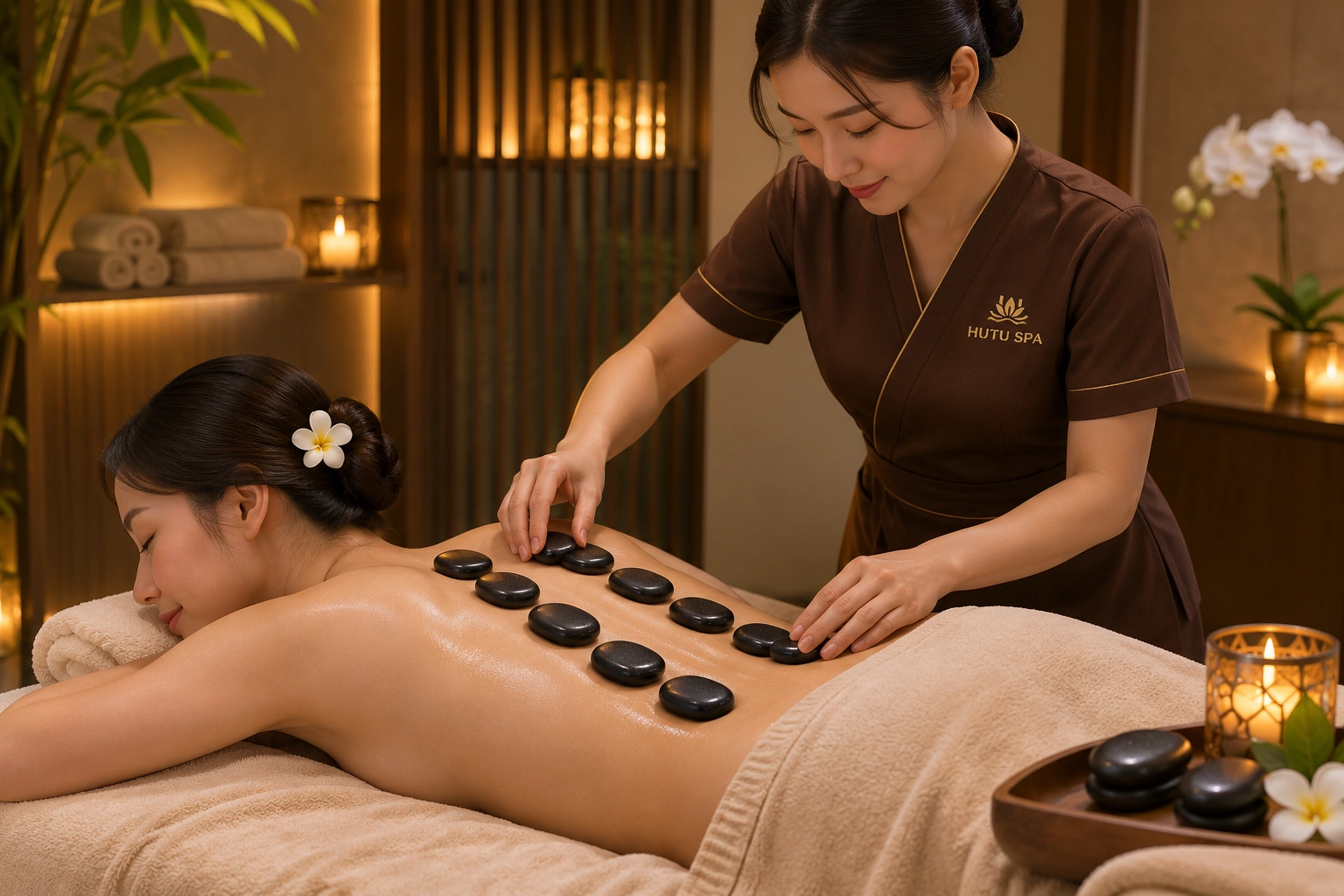
How are basalt stones heated and used during a massage?
Basalt stones are soaked in a dedicated water heater until they reach a stable warmth, then placed still on the body (over a towel) or held in the therapist's hand to glide over a layer of massage oil.
What temperature is safe?
WebMD recommends heating the water to 110 to 130°F, or about 43 to 54°C, with the water fully covering the stones. Some other sources cite the University of New Hampshire with a range of 130 to 145°F, or about 54 to 63°C.
Many Vietnamese-language articles mistakenly give this figure as "130 to 145°C". This is a unit conversion error: water in a heater at normal pressure cannot go above 100°C, and a stone at 130°C would cause a serious burn instantly.
| Source | Original temperature | Converted |
|---|---|---|
| WebMD (stone-heating water) | 110 to 130°F | 43 to 54°C |
| University of New Hampshire (cited by Healthline) | 130 to 145°F | 54 to 63°C |
| Wikipedia (stone massage) | 38 to 60°C | 38 to 60°C |
These figures are only reference points. The more important rule is that the therapist must be able to hold the stone comfortably. If their hand cannot hold it, the stone is too hot for the guest's skin. Professional spas use a calibrated thermometer to check the water and never heat stones in a microwave, oven, slow cooker, pan or electric heating pad.
The basalt hot stone massage process at a spa
- Consultation: the therapist asks about your health, the muscles you want to focus on and how warm you like it.
- Preparing the stones: clean stones are arranged in the heater by size, and the water is checked with a thermometer and by hand.
- Warming the muscles by hand: the therapist applies essential oil and massages by hand for a few minutes so your skin and muscles adjust.
- Placing the stones: large stones are placed over a towel along both sides of the spine, in the palms or on the abdomen. Small stones may be placed between the toes.
- Massaging with the stones: the therapist holds the stones to perform long strokes, circles, light vibration and kneading using Swedish techniques. Any stone that cools is swapped right away for a fresh one.
- Cold stones (depending on the treatment): some places use cool marble stones at the end to soothe the skin.
- Rest: you lie still for a while before sitting up, drink warm water and avoid standing up too quickly.
Throughout the session, stones should not stay in one place for too long, and you have the right to speak up as soon as anything feels too hot. If this is your first spa visit, the general tips for your first massage, such as what to wear, what to eat beforehand and how to ask for different pressure, also apply to hot stone massage.
Who should and should not have a basalt hot stone massage?
Basalt hot stone massage suits most healthy adults who want deep relaxation, but it is not for everyone. Heat is good for the muscles but is a risk for some health conditions.
Who usually enjoys hot stones
- Office workers with stiff necks and shoulders or a sore lower back from sitting for long periods.
- People who often have cold hands and feet or simply love feeling warm.
- People who want softer muscles but dislike very firm pressure, since the warmth reduces the need for force.
- Travellers who have walked a lot, sat through long journeys or slept poorly in a new place.
Who should avoid it or ask a doctor first
Medical sources such as WebMD and Healthline list the following cases as needing caution:
- Pregnant women: most therapists do not use hot stones on pregnant clients. Only have a massage with your doctor's approval, performed by someone trained in prenatal massage.
- People with bleeding disorders, those taking blood thinners, or anyone with a history of blood clots.
- People with diabetes or peripheral neuropathy: the skin may be less sensitive to heat, making it hard to notice when a stone is too hot.
- People with heart disease, epilepsy, cancer or severe osteoporosis.
- People who have had surgery within the past 6 weeks, unless their doctor allows it.
- People with open wounds, burns, varicose veins or skin conditions such as psoriasis or eczema, because heat can irritate the skin further.
- People who have just been drinking alcohol, because alcohol reduces your ability to sense heat.
A special note for beachgoers
In a beach city like Nha Trang, a common situation is a guest arriving straight from sunbathing with reddened skin. Sunburn is a mild burn, so hot stones should not be placed on those areas. Let your therapist know in advance so they can avoid the sore skin, lower the heat or switch to an oil massage without stones.
If you are not sure whether your condition is suitable, the safest approach is to ask your doctor and tell the therapist clearly before you start.
How to choose, identify and care for basalt massage stones
Good basalt massage stones are dense, heavy in the hand, evenly dark, smooth and free of cracks. The criteria below are useful both if you want to buy a set for home use and if you want to judge the quality of the stones at the spa you visit.
Signs of genuine, good-quality basalt
- Heavy in the hand: with a density of about 2.9 g/cm³, a basalt stone feels much heavier than it looks. Plastic or compressed-powder stones usually feel light and "hollow".
- Even colour: dark grey to black, sometimes with faint natural veining. A lacquer-like black shine, or colour coming off on a white oiled cloth, suggests the stone has been dyed or coated.
- No pores: the surface is continuous, without the air holes found in pumice. Put a drop of water on the stone; if it soaks in quickly, the stone is porous and stains easily.
- Rounded, unchipped edges: the stone should be smooth from face to edge. Even a small chip can scratch the skin as it glides.
- Stays warm for a long time: soaked in the same water, good basalt stays evenly warm noticeably longer than porous or thin stones.
What is in a hot stone massage set?
Sets on the market usually contain from 8 to more than 50 stones, grouped by use:
- Large stones (about 8 x 8 cm, about 2 cm thick): placed still on the back, thighs and abdomen.
- Medium oval stones (about 6 x 8 cm): held in the hand to glide along the shoulders, arms and calves.
- Small stones (about 3 x 4 cm): tucked between the toes or used on the face and narrow areas.
A popular 16-stone set includes 4 oval stones, 4 round stones and 8 small stones. Spas usually need more stones so there is always a hot one ready when the one in use cools down.
Cleaning and caring for basalt stones
- After each guest, wash the stones in warm water with mild soap to remove the massage oil, then disinfect them according to the spa's procedure.
- Dry them and store them in a well-ventilated place, without stacking, to avoid knocks.
- Change the water and clean the inside of the heater every day.
- Never put cold stones into boiling water, as sudden temperature changes can cause hidden cracks.
- Check the stones regularly and discard any that are cracked or chipped. When the stones look dull, rub on a thin layer of oil and wipe them to restore their black shine.
If you want to use basalt stones at home
Use a stone heater with temperature control and a thermometer, always put a towel underneath when placing stones and never leave a stone in one spot for too long. If you have no training, use warm stones only for gentle compresses and leave deep massage to a therapist.
Frequently asked questions about basalt massage stones (FAQ)
Are basalt stones and volcanic massage stones the same thing?
Almost. "Volcanic stone" is a general name for rock formed from lava, and basalt accounts for more than 90% of it. When a spa talks about "hot volcanic stones", it is almost always using basalt.
Why are basalt stones black?
Basalt's dark colour comes mainly from the mineral pyroxene and its high iron and magnesium content. After polishing and contact with massage oil, the stones look glossier and blacker than in their raw state.
Do basalt stones release minerals or "draw out toxins" through the skin?
No. Basalt is a solid, dense rock that is stable in hot water, so it does not dissolve minerals into the skin during a massage of a few dozen minutes. The effect of the stones comes from heat and weight, not from "energy" or minerals.
Can a basalt hot stone massage burn the skin?
It can if the stones are too hot, placed directly on the skin without a barrier or left in one place too long. When the water is controlled with a thermometer, resting stones are placed on a towel and the guest speaks up as soon as something feels hot, the risk of burns is very low.
How long do basalt stones stay warm?
How long a stone stays warm depends on its size, thickness and starting temperature. A large stone resting on a towel stays warm much longer than a small stone gliding over the skin. That is why therapists always rotate several stones in the heater so the warmth is never interrupted.
How long does a hot stone massage last?
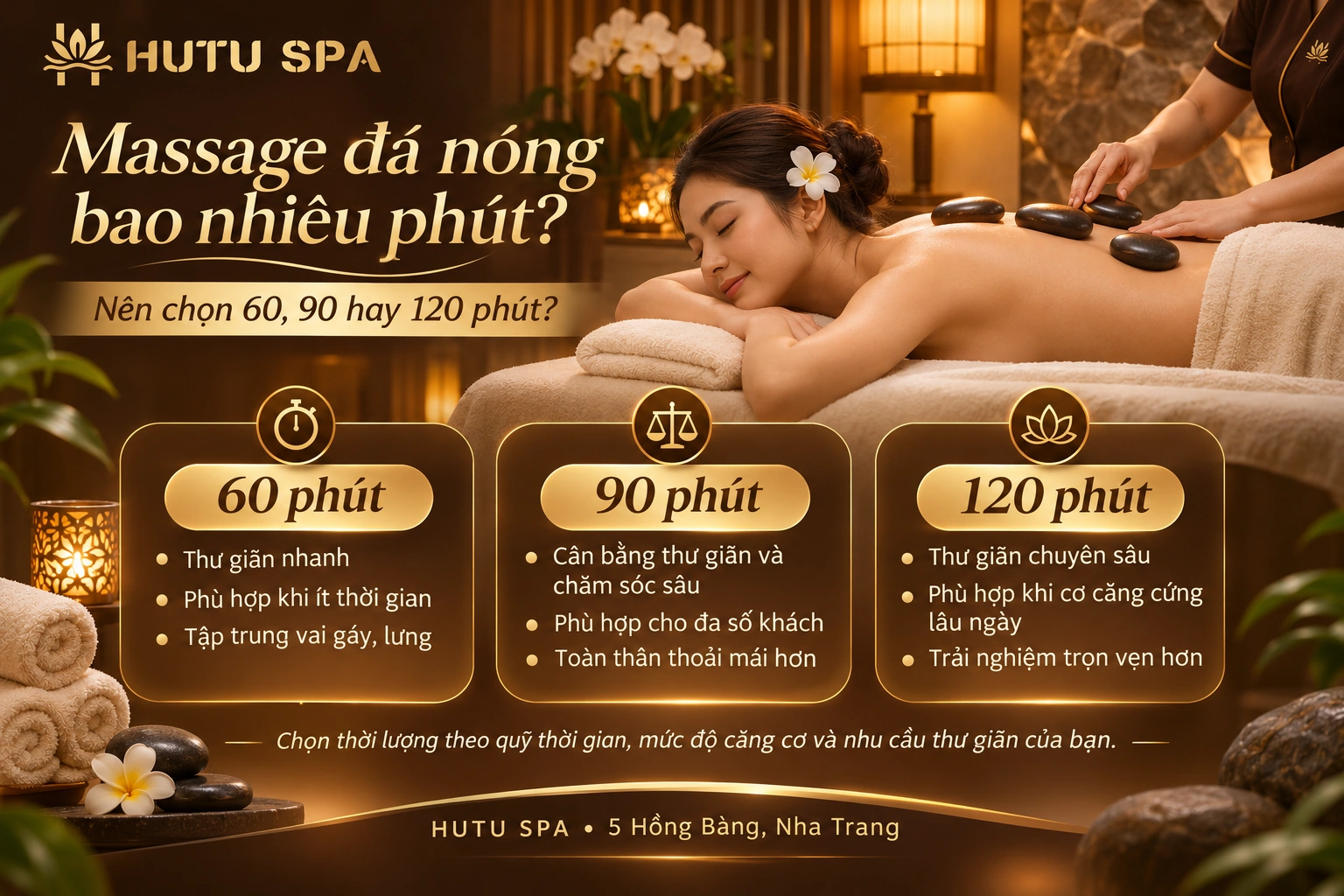
Usually 60 to 90 minutes. A 60-minute session is good for getting to know the treatment, while 90 or 120 minutes gives the therapist time for both resting stones and a full-body massage.
How are basalt massage stones different from lava beads in bracelets?
Lava beads for jewellery are porous volcanic stone full of air holes, so they are light and absorb oil. Basalt massage stones are dense and heavy, with a continuous, polished surface. Both come from volcanoes, but their uses are completely different.
Should I buy basalt stones to use at home?
You can, if you use a heater with a thermometer and only use warm stones for compresses or light massage. For a full-body massage with stones placed along the back, a trained therapist will control the heat and pressure more safely.
Conclusion: basalt is the "secret" behind the warmth of hot stone massage
Basalt massage stones have no magic, but they have exactly the physical properties a hot stone needs: dense and heavy to store heat, slow to conduct heat so the warmth sinks in gradually, smooth to glide gently over the skin and durable enough to be soaked in hot water every day. That is why, from LaStone Therapy in 1993 to today's spas, basalt remains the standard choice for hot stone massage.
When choosing where to try it, look for three things: the stones are heated in water in a dedicated heater, the therapist asks carefully about your health before the session, and you can adjust the heat at any time.
Experience basalt hot stone massage at Hutu Spa Nha Trang
At Hutu Spa, the Hutu Signature treatment combines natural essential oils with the warmth of heated volcanic stones and hand massage techniques to help your body gradually let go. You can choose 60, 90 or 120 minutes, with prices from VND 340,000 for 60 minutes (prices and offers may vary by day of the week).
If you are sensitive to heat, let us know in advance so your therapist can lower the warmth or suggest a treatment without stones.
- Address: 5 Hong Bang, Nha Trang, Khanh Hoa
- Opening hours: 10:00 to 22:00 daily, bookings accepted until 21:00
- Hotline: 0396 161 183 (Zalo, WhatsApp, KakaoTalk, Viber)
This article is for reference only and does not replace medical advice or treatment.