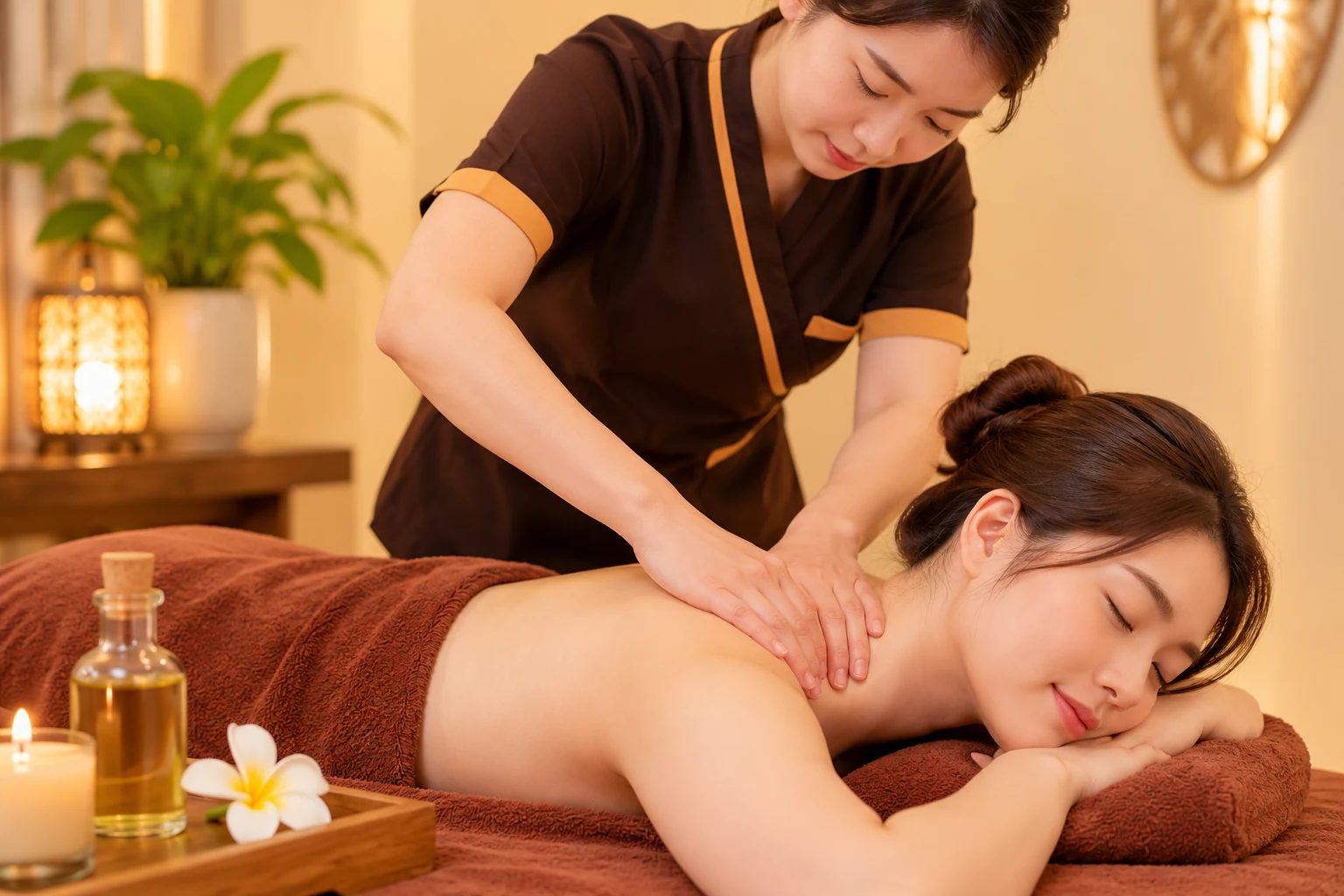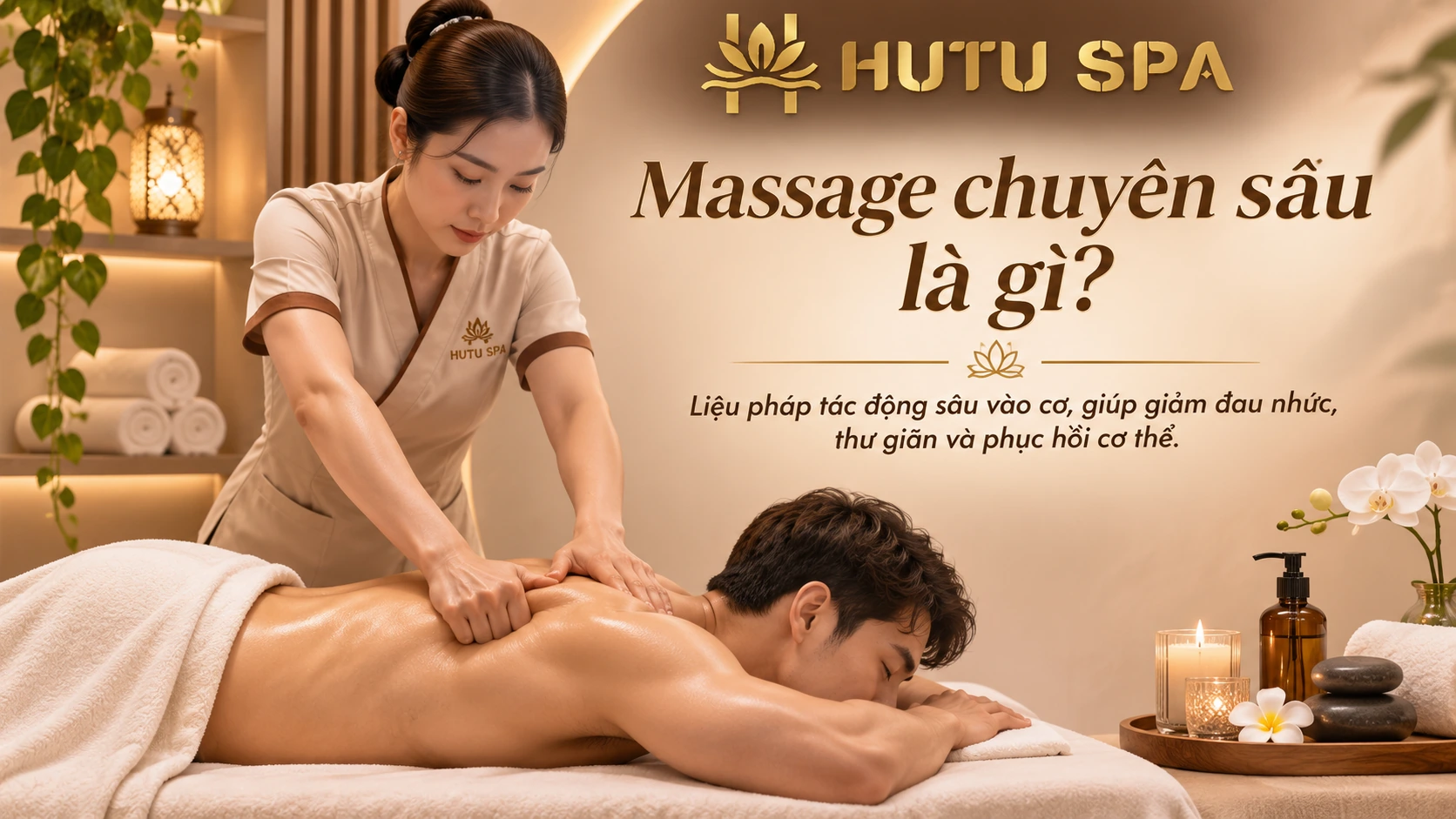
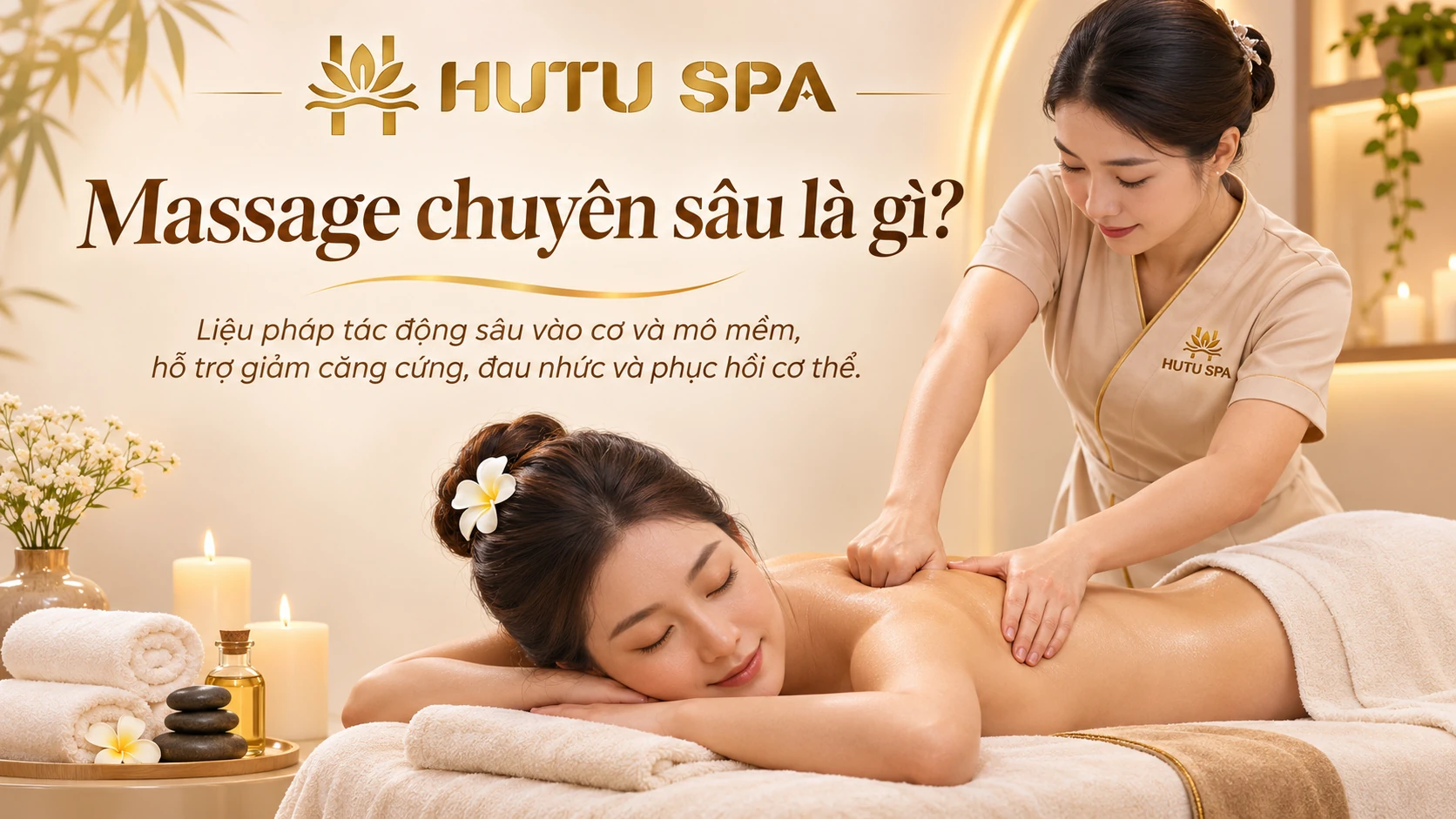
Deep tissue massage is a technique that uses slow strokes and sustained pressure to work on the deeper layers of muscle and connective tissue, rather than only relaxing the surface. It is a common choice for people who often have an aching back, neck and shoulders from sitting for long hours, people who are physically active, and anyone who finds a relaxation massage "just not enough". In return, deep tissue massage can leave you sore for a few days, and it is not suitable for everyone. This article explains how the technique works, which benefits have scientific support, how much discomfort is normal, who should avoid it, and how often to get one.
Quick summary
- Deep tissue massage (also called deep muscle massage) uses medium to firm pressure and focuses on muscle areas that have stayed tight for a long time.
- It suits people with muscle aches caused by posture, people who train regularly, and people who are already used to massage.
- Keep the pressure at about 5 to 7 on a 10-point scale: clearly sore, but you can still breathe evenly.
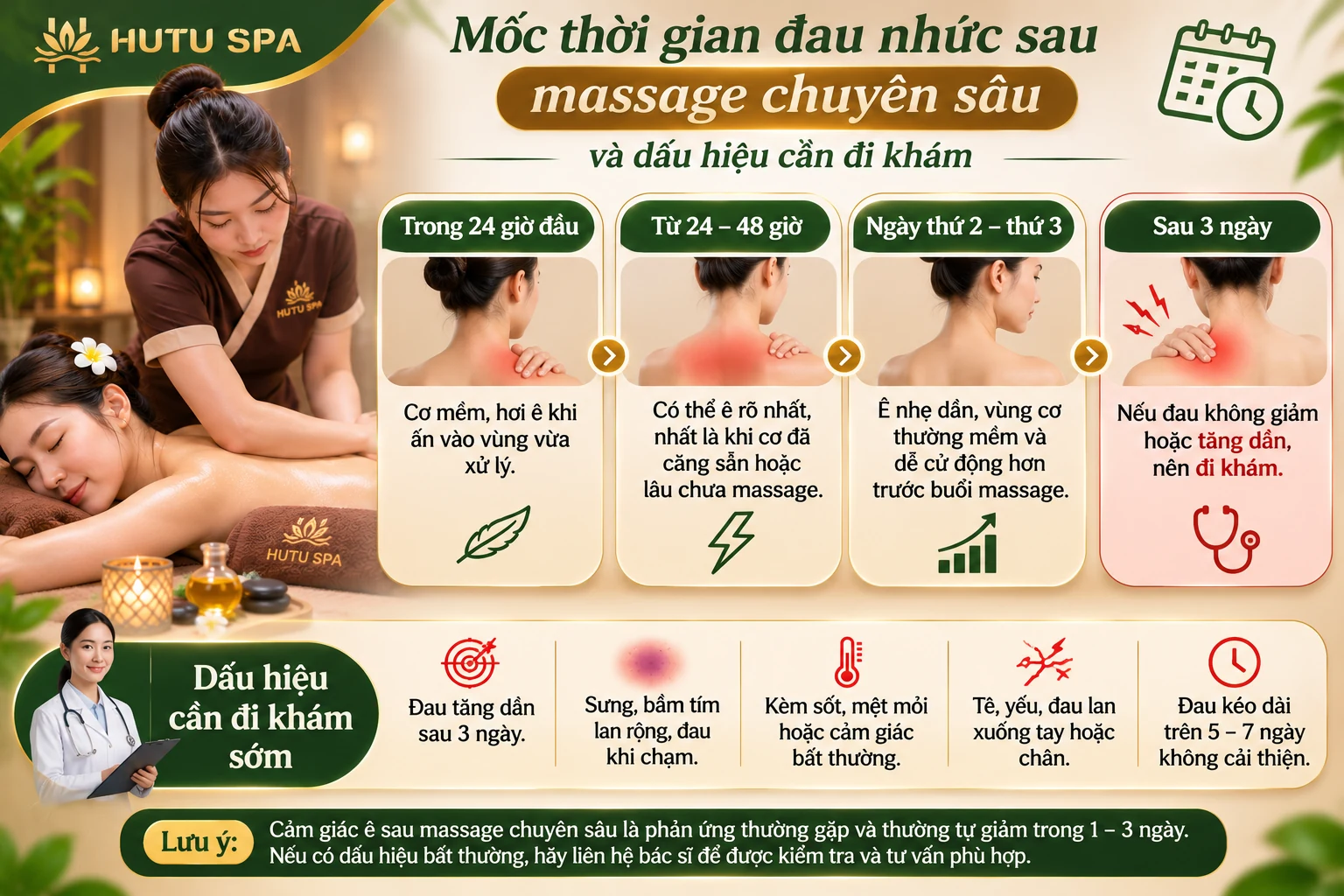
- Soreness for 24 to 48 hours after a session is normal. It can last 2 to 3 days and gradually eases.
- People with osteoporosis, blood clots, those taking blood thinners, pregnant women and anyone who has just had surgery should avoid it or ask their doctor first.
- The usual session length is 90 to 120 minutes; a reasonable maintenance rhythm is once every 2 to 4 weeks.
What is deep tissue massage?
Deep tissue massage, also known as deep muscle massage, is a massage technique that uses slow strokes and steady pressure to work on the muscle layers beneath the surface and the connective tissue surrounding them. According to Vinmec, this method is often used to relieve chronic pain and improve the range of motion of muscles, bones and joints. The main goal is not to put you to sleep, but to ease areas of muscle that have been tight for a long time so the body can move more freely.
What deep tissue massage works on
The body has many layers of muscle stacked on top of each other. A relaxation massage mainly warms up and loosens the superficial layer. Once that layer has softened, the therapist can use deeper pressure to reach the muscle groups underneath, such as the muscles running along both sides of the spine, the trapezius at the shoulders, or the gluteal muscles.
The areas treated most often are "muscle knots": localized tight spots that feel hard to the touch, and when pressed cause pain or a tightness that spreads outward. They usually form from sitting for long periods, poor posture, carrying heavy loads, or repeating the same movement over a long time.
Commonly used techniques
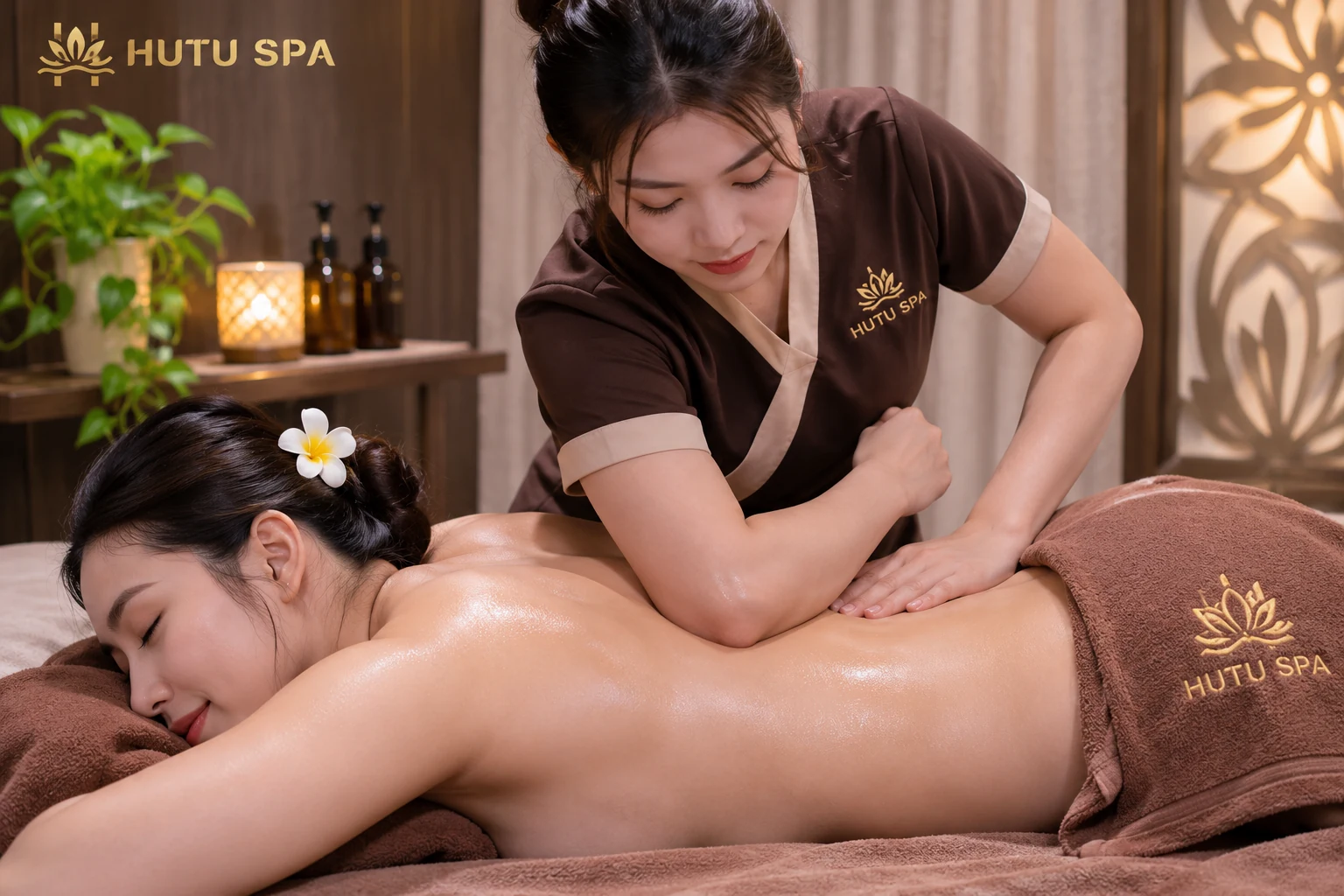
- Slow strokes along the muscle fibers: steady pressure at a much slower pace than a relaxation massage, so the muscle does not reflexively tighten.
- Sustained pressure on tight points: holding steady pressure on a knot until the feeling of tension eases.
- Cross-fiber friction: short movements across the direction of the muscle fibers to soften stuck, hardened areas.
- Using the forearm, elbow and knuckles: creates deep and broad pressure without concentrating all the force on a single fingertip.
- Gentle stretching: combined after the work so the muscle lengthens and relaxes.
Slow speed is the key. If the pressure is deep but the movement is fast, the muscle will tense up to protect itself, making the session both painful and less effective.
How deep tissue massage differs from relaxation massage
Deep tissue massage belongs to the group of therapeutic massage because it targets a specific problem, such as stiff shoulders or a tired back, rather than simply giving an all-over feeling of comfort. The difference shows up in five ways:
- Goal: full-body relaxation versus working on a specific tight muscle area.
- Pressure: light to medium versus medium to firm.
- Pace: even, flowing rhythm versus slow, with long pauses on tight spots.
- Sensation: soft and sleepy versus clearly sore in tight areas, requiring you to focus on your breathing.
- Afterwards: feeling lighter right away versus possibly being sore for 1 to 3 days before the muscle feels fully soft.
Deep tissue massage compared with other popular massage types
Deep tissue massage has the firmest pressure among oil-based massages, comparable to Thai massage but more focused on individual muscle areas. The table below is condensed from Hutu Spa's article comparing types of massage by pressure, sensation and price, keeping only the types that are often confused with deep tissue massage.
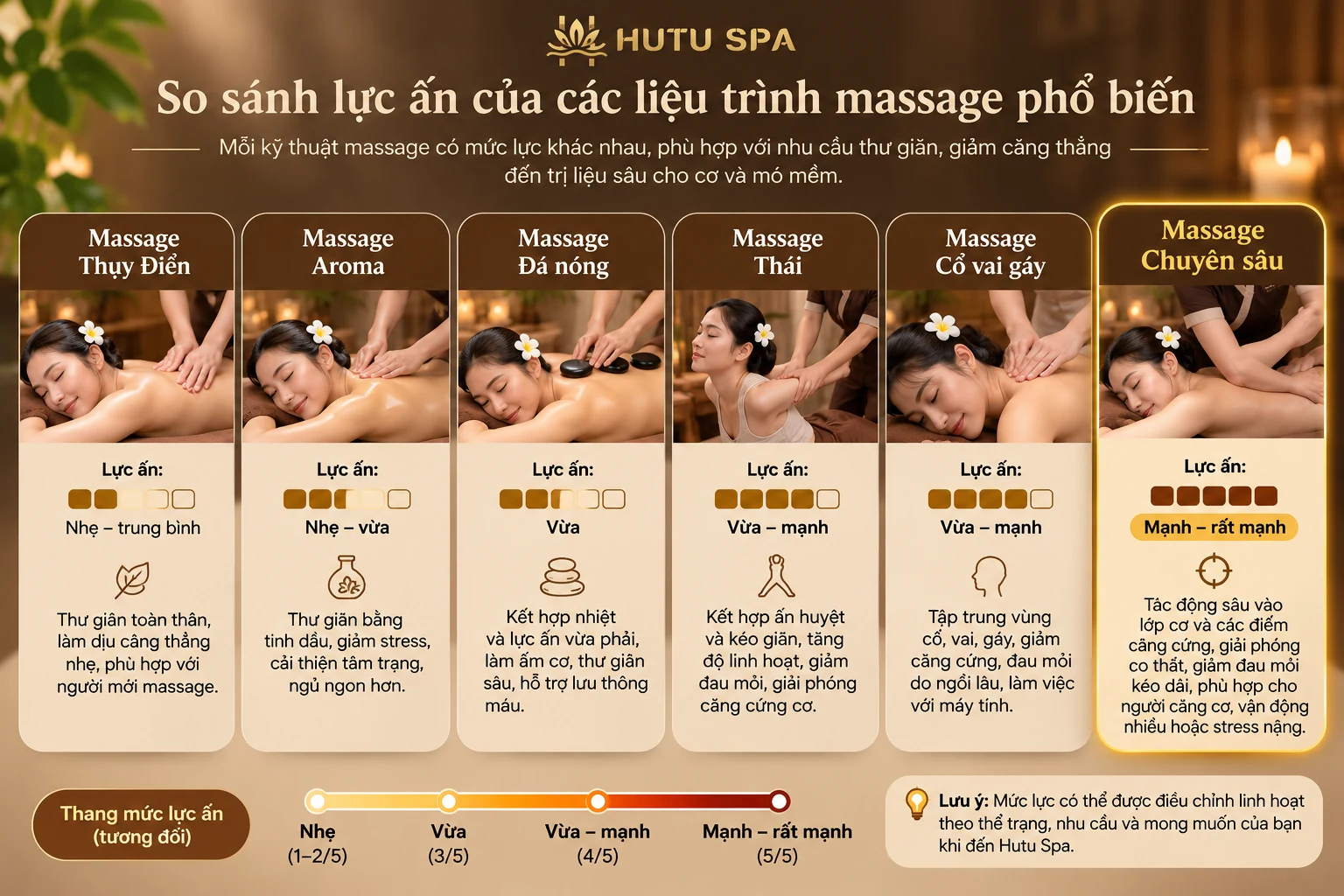
| Type of massage | Pressure | Main goal | Oil and clothing | Typical duration |
|---|---|---|---|---|
| Deep tissue massage | Medium to firm | Ease long-standing muscle tension in specific areas | With oil, partly undressed, covered with a towel | 90 to 120 minutes |
| Swedish | Light to medium | Full-body relaxation | With oil, partly undressed, covered with a towel | 60 to 90 minutes |
| Aromatherapy | Light to medium | Relaxation, stress relief | Diluted essential oils, covered with a towel | 60 to 90 minutes |
| Hot stone | Medium | Warming and softening the muscles | With oil, covered with a towel | 60 to 120 minutes |
| Thai | Medium to firm | Stretching, improving flexibility | Usually no oil, loose clothing | 60 to 120 minutes |
| Neck and shoulder | Medium | Working specifically on the neck and shoulders | With oil, top off or spa clothing | 30 to 60 minutes |
Deep tissue massage and Swedish massage
These two share many basic movements such as gliding, kneading and long strokes. The difference lies in speed and depth: Swedish massage moves in an even rhythm across the whole body to relax, while deep tissue massage slows down and stays longer on tight areas. In practice, a properly done deep tissue session usually opens with a few minutes of light Swedish-style strokes to warm up the muscles.
Deep tissue massage and Thai massage
Thai massage also uses strong pressure, but the guest wears loose clothing, no oil is used, and the body is stretched into many positions. Deep tissue massage uses oil for slow strokes along the muscle fibers, which suits you better when you want to work thoroughly on one area such as the lower back or shoulder blades rather than stretch the whole body.
Deep tissue massage and sports massage
Sports massage is designed around a training schedule and can be done before or after competition, with a faster pace and more stretching movements. Deep tissue massage is slower and aimed at chronic tension, so it is usually scheduled on a rest day rather than right before a hard workout.
Benefits of deep tissue massage: what has evidence behind it
The benefit with the clearest evidence is short-term relief of pain and muscle tension, especially in the back, neck and shoulders. Promises such as "detoxing" or "melting fat" have no basis.
Relieving chronic back pain
A randomized trial in Poland published in 2014 (Majchrzycki et al.) gave people with chronic lower back pain 10 deep tissue massage sessions of 30 minutes each over 2 weeks. The massage-only group's pain score fell from 58.3 to 42.2 on a 100-point scale, and their ability to carry out daily activities also improved. The group that received massage plus an anti-inflammatory painkiller improved as well, and the two groups did not differ significantly.
Even so, this is a small study. NCCIH, part of the US National Institutes of Health, rates the overall evidence for massage and back pain as low quality, with effects that are mainly short-term. Deep tissue massage should therefore be seen as a supportive measure alongside exercise and posture correction.
Easing neck and shoulder tension from long sitting
According to NCCIH, massage may help reduce neck and shoulder pain, but the effect is usually short-term. For neck pain, sessions need to be long enough and frequent enough to show results. This is why deep tissue massage often lasts 90 minutes or more and works best on a regular schedule rather than as a one-off when the pain is already severe.
Easier movement
Cleveland Clinic states that therapeutic massage helps soften tight muscles and increase range of motion. It can support conditions such as back pain, frozen shoulder, muscle tension, tendinitis, and injuries from holding one posture while working at a desk for long periods. People who often look down at their phones, drive long distances or sit at a computer usually notice this when turning the neck or shrugging the shoulders after a session.
Supporting recovery after exercise
Also according to Cleveland Clinic, therapeutic massage increases blood circulation and lymphatic drainage, which helps reduce swelling and inflammation. Runners, gym-goers and people who play sports often use deep tissue massage on rest days to keep their muscles from stiffening. However, massage is only a supplement; it cannot replace sleep, nutrition and rest between workouts.
Mental relaxation
When an area of long-standing pain eases, the whole body feels lighter. Many people say they fall asleep more easily the night after a session, even though parts of the massage felt quite sore.
What deep tissue massage cannot do
- It does not "detox": there is no evidence that massage flushes toxins or lactic acid out of the muscles. Drinking water after a session simply replaces lost fluid.
- It does not melt fat or help with weight loss: pressure cannot burn fat tissue.
- It does not realign bones or cure a herniated disc: these conditions need diagnosis and treatment by a doctor.
- It does not replace seeing a doctor: NCCIH advises against using massage to delay seeing a doctor when you have a health problem.
Who should and should not get deep tissue massage
Deep tissue massage suits healthy people with muscle areas that have been tight for a long time, but its firm pressure also means there are more cases to avoid than with relaxation massage.
Who deep tissue massage suits
- Office workers who sit a lot and often have a tired neck, shoulders and lower back.
- People who do manual work, carry heavy loads or stand for long hours.
- Runners, gym-goers and athletes who want their muscles less stiff on rest days.
- People already used to massage who find medium pressure not enough.
- People with long-standing tight muscles that limit turning the neck, bending over or raising the arms.
If you have a low pain threshold or have never had a massage, start with Swedish or aromatherapy massage, or ask the therapist to keep the pressure at a medium level for your first session.
Who should avoid it or ask a doctor first
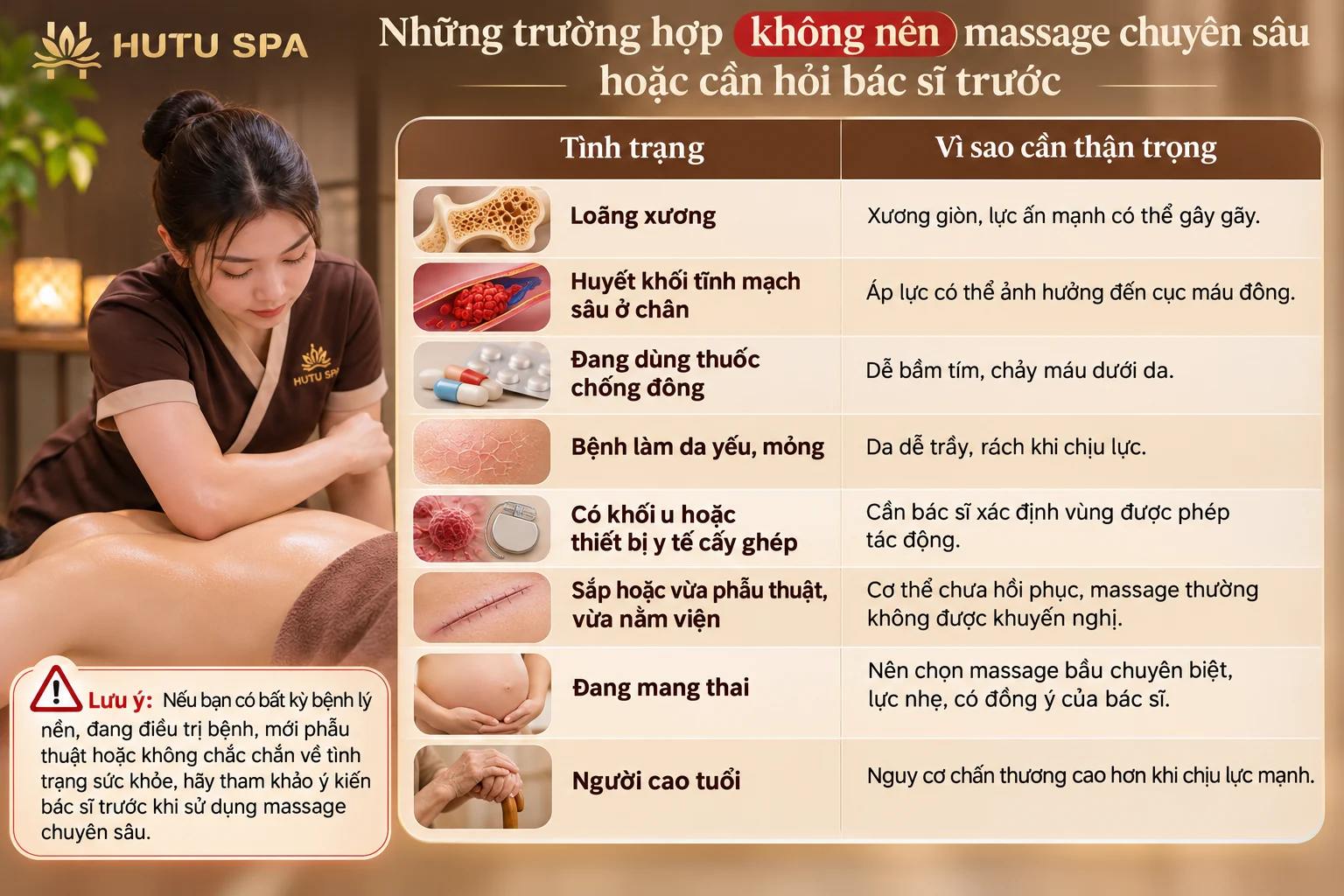
Cleveland Clinic advises talking to your doctor before therapeutic massage if you fall into any of the groups below. For deep tissue massage this advice matters even more because the pressure is firmer.
| Condition | Why caution is needed |
|---|---|
| Osteoporosis | Bones are brittle, and firm pressure may cause a fracture |
| Deep vein thrombosis in the legs | Pressure may affect a blood clot |
| Taking blood thinners | Bruising and bleeding under the skin come easily |
| Conditions that make the skin weak or thin | Skin is easily scraped or torn under pressure |
| A tumor or an implanted medical device | A doctor needs to confirm which areas can be worked on |
| Upcoming or recent surgery, or a recent hospital stay | The body has not recovered, and massage is generally not recommended |
| Pregnancy | Choose a dedicated prenatal massage with light pressure and your doctor's approval |
| Older adults | Higher risk of injury under firm pressure |
NCCIH states that the risk of harm from massage is generally low. Even so, some rare but serious events such as blood clots, nerve damage and bone fractures have been reported, and many of these cases involved vigorous techniques such as deep tissue massage or older adults.
When to reschedule
- You have a fever, a cold or flu, or feel exhausted.
- You have a fresh injury such as a sprain or an acute muscle strain with swelling and heat.
- You have an open wound, a skin infection or sunburn on the area to be massaged.
- You have just been drinking alcohol.
- You have just eaten a heavy meal; wait about 1 to 2 hours after eating.
- Your muscles are still sore from a previous deep tissue session.
What a deep tissue massage session at a spa looks like
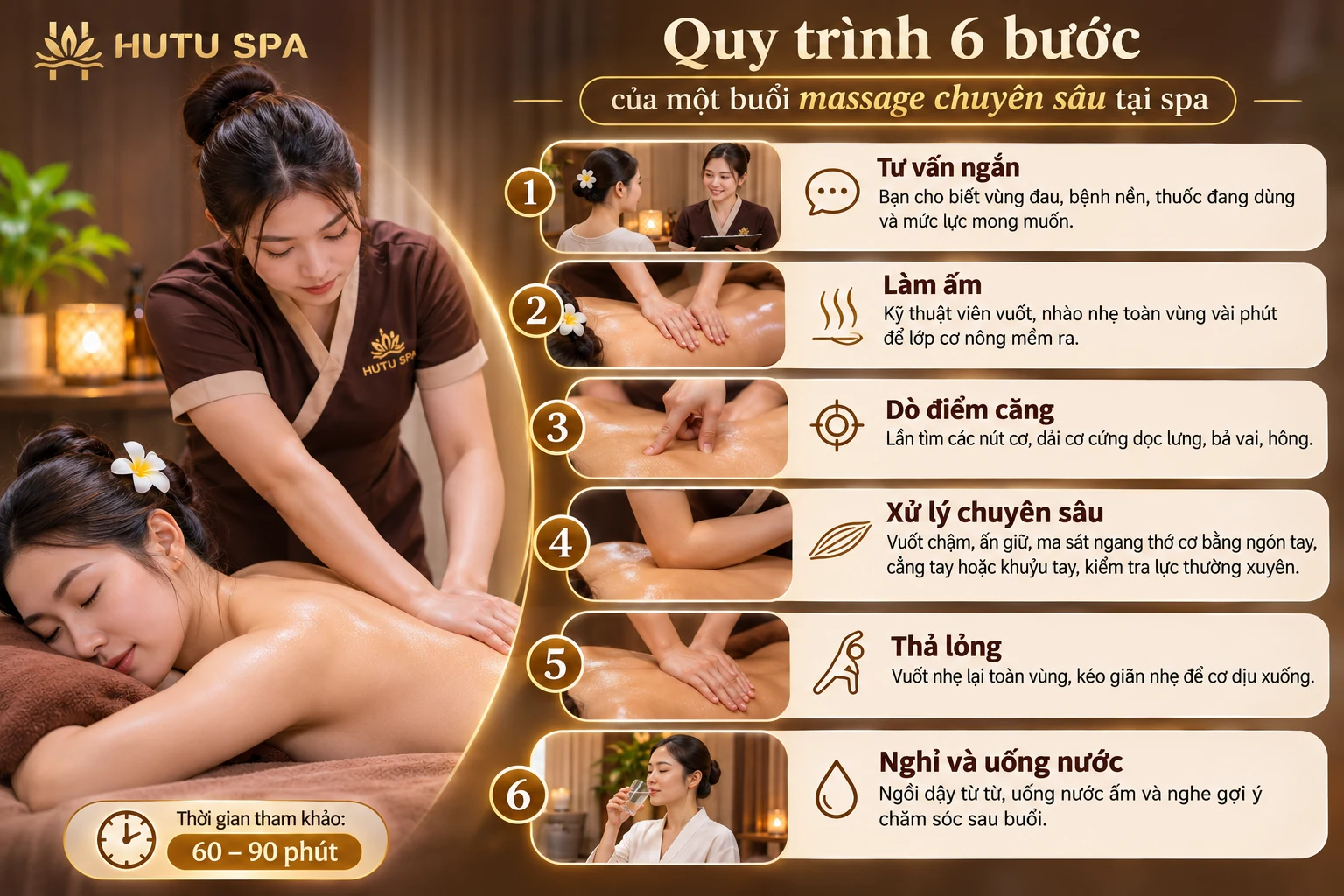
A properly done deep tissue session always moves from light to deep and never applies firm pressure from the very first minute. Vinmec describes the therapist asking about the problem area, using gentle strokes to warm the muscles, and only then applying deep pressing and gliding movements at varying levels of pressure.
- Short consultation: you tell the therapist your problem area, any underlying conditions, medications you take, and the pressure you want.
- Warm-up: the therapist glides and kneads the whole area lightly for a few minutes so the superficial muscle layer softens.
- Locating tight spots: feeling for muscle knots and hardened bands along the back, shoulder blades and hips.
- Deep work: slow strokes, sustained pressure and cross-fiber friction using the fingers, forearm or elbow, with frequent pressure check-ins.
- Release: light strokes over the whole area again, with gentle stretching so the muscle settles.
- Rest and hydrate: sit up slowly, drink warm water and listen to suggestions for aftercare.
Does deep tissue massage hurt?
It can feel sore, especially when the therapist works on a muscle knot. Cleveland Clinic describes therapeutic massage as usually deeper than relaxation massage and sometimes causing a "good pain", but if the pain feels abnormal you must say so right away. The simplest way to communicate with your therapist is to use a scale from 1 to 10.
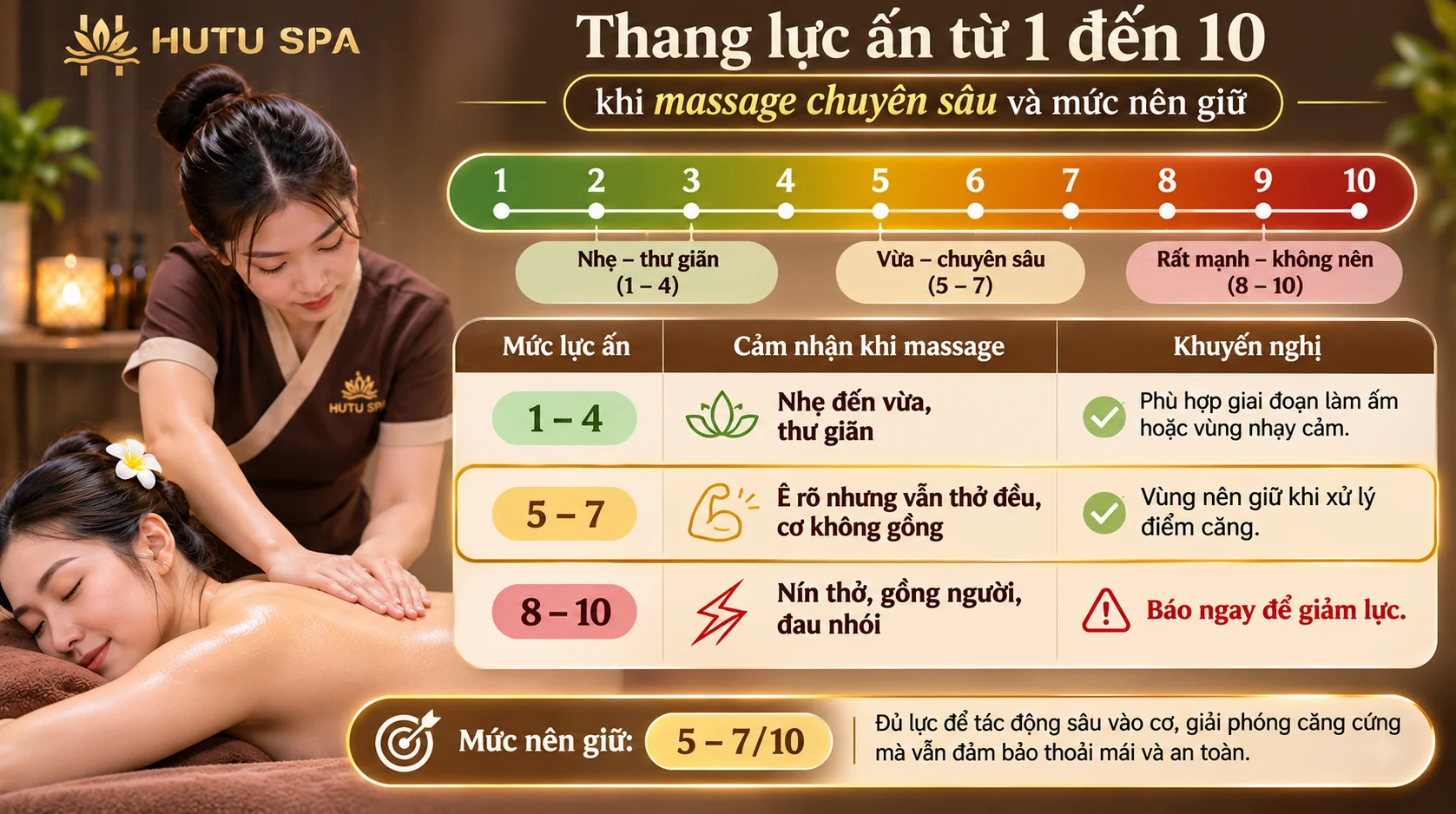
| Score | Sensation | What to do |
|---|---|---|
| 1 to 4 | Light to medium, relaxing | Suitable for the warm-up phase or sensitive areas |
| 5 to 7 | Clearly sore but you can still breathe evenly, and the muscle is not tensing | The range to keep when working on tight spots |
| 8 to 10 | Holding your breath, tensing up, sharp pain | Tell the therapist immediately to reduce the pressure |
When the pain goes above 7, the muscle tenses to protect itself and the massage loses its effect. Stop right away if you feel numbness spreading down your arms or legs, sharp electric-shock-like pain, dizziness or nausea.
How long does soreness after deep tissue massage last?
Being sore after a massage is quite common, especially after deep tissue massage. The feeling is similar to after a workout, usually easing within 24 to 48 hours; it can last 2 to 3 days and fade a little each day. The milestones to watch:
- Within the first 24 hours: the muscle feels soft and slightly sore when pressed over the area that was just worked on.
- From 24 to 48 hours: soreness may peak, especially if the muscle was already tight or it has been a long time since your last massage.
- Day 2 to day 3: soreness gradually fades, and the muscle is usually softer and moves more easily than before the session.
- After 3 days: if the pain does not ease or keeps getting worse, see a doctor.
Go to a medical facility right away if you have a large swollen bruise, numbness or weakness in the arms or legs, swelling and pain in one calf, or unusually dark urine.
How often should you get a deep tissue massage?
For healthy people who want to maintain results, once every 2 to 4 weeks is a reasonable rhythm. When you have a tight muscle area that needs work, you can have one session a week for the first few weeks and then space them out. The most important rule is not to get deep tissue massage on the same area again while the muscle is still sore from the previous session.
| Goal | Suggested frequency | Duration |
|---|---|---|
| Maintenance, easing work-related tension | Once every 2 to 4 weeks | 90 minutes |
| Ongoing neck, shoulder or back tension | Once a week for 3 to 4 weeks, then space out | 90 minutes |
| High-intensity training | Once every 1 to 2 weeks, on rest days | 90 to 120 minutes |
| First time trying | One session, wait until the soreness is gone before booking the next | 90 minutes, medium pressure |
The back pain study mentioned above used 10 sessions over 2 weeks, but that was a monitored clinical treatment program, not a schedule for a spa. If you need more than one massage a week before you feel any relief, that is a sign to see a doctor or a physiotherapist.
Should you choose the 90- or 120-minute package?
- 90 minutes: enough for the whole body plus 1 to 2 priority areas such as the neck and shoulders and the lower back. Suitable for most people.
- 120 minutes: suits having several tight areas at the same time, for example the neck and shoulders, back and calves after a race, or when you want a slow pace with time to unwind.
- Under 60 minutes: deep tissue massage needs time to warm up, so a short package only covers one area. If only your neck and shoulders are tired, a 30 to 60 minute neck and shoulder massage is usually more reasonable.
Preparing for and caring for yourself after a deep tissue massage
Good preparation makes the session more effective, and good aftercare reduces soreness and helps you stay feeling light for longer.
Before the session
- Eat lightly about 1 to 2 hours beforehand; do not go when too full or too hungry.
- Do not drink alcohol on the day of your massage.
- Shower beforehand and do not put thick lotion on your skin.
- Note down your painful areas, underlying conditions and medications so you can tell the therapist.
- Arrive about 10 minutes early so you are not rushed, which also helps your muscles relax.
If this is your first time getting a massage, say so clearly so the therapist can start at medium pressure and increase it gradually based on your feedback.
After the session
- Drink warm water and stay hydrated throughout the day.
- Rest and avoid heavy exercise of the massaged area for about 24 hours.
- Walk and stretch gently so the muscles do not stiffen again.
- Take a warm shower or apply a warm compress to the sore area; use a cool compress if the area is swollen and hot.
- Do not press hard on the area yourself or ask someone to massage it again while it is still sore.
- Watch for the warning signs described above during the first 3 days.
How to choose a safe place for deep tissue massage
For deep tissue massage, the therapist's skill matters more than a luxurious setting. Firm pressure applied in the wrong place is not only painful but can also cause bruising or injury. Before booking, check the following:
- The therapist asks about your problem area, underlying conditions and medications before starting.
- The session starts gently and builds up gradually, and the therapist asks about the pressure several times.
- The therapist is ready to reduce the pressure as soon as you say so, and does not insist that it must hurt to work.
- No promises to cure diseases, melt fat or detox.
- A price list that clearly states the duration and weekday and weekend prices.
- A clean private room, proper draping with towels, and massage oil of clear origin.
- Genuine Google Maps reviews that mention pressure and therapists' names.
Deep tissue massage at Hutu Spa Nha Trang
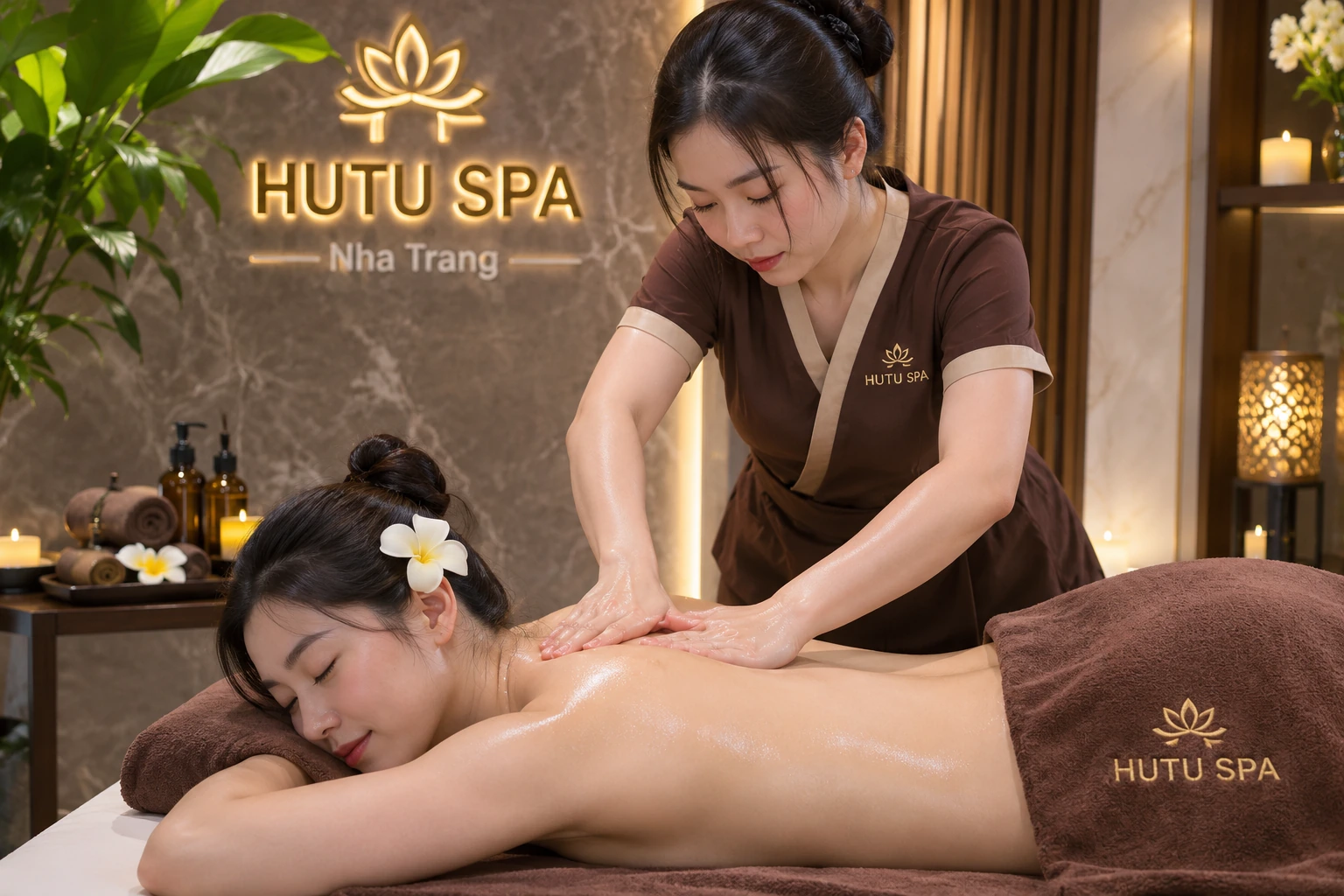
Hutu Spa offers a specialized deep tissue massage with essential oils, using deep pressure on tight, tired muscle groups to help ease long-standing muscle tension, relieve aches and support recovery after days of heavy activity or prolonged stress. Because deep tissue massage needs time to warm up and to work carefully, the spa offers only two packages, 90 and 120 minutes.
| Duration | Monday to Friday | Saturday, Sunday |
|---|---|---|
| 90 minutes | ~VND 610,000 | ~VND 680,000 |
| 120 minutes | ~VND 810,000 | ~VND 890,000 |
The prices above include the promotion applied at the time this article was updated (original price VND 760,000 for 90 minutes and VND 990,000 for 120 minutes) and may change with promotions. Please confirm by phone before you visit.
Hutu Spa is at 5 Hong Bang, Nha Trang Ward, Khanh Hoa, open daily from 10:00 to 22:00 and accepting guests until 21:00. When booking by hotline or Zalo at 0396 161 183, tell the team which area you want to focus on and any underlying conditions you have. If only your neck and shoulders are tired, or you want medium pressure with the warmth of hot stones, the therapist may suggest the neck and shoulder massage or the Hutu Signature as a better fit.
Frequently asked questions about deep tissue massage
Does deep tissue massage hurt?
It can feel sore at tight spots, but it should not hurt so much that you hold your breath or tense your body. A suitable level is about 5 to 7 on a 10-point scale. Tell the therapist right away when the pressure goes beyond this level, or when you feel sharp pain or spreading numbness.
Should I choose deep tissue massage for my first massage?
No, not if you do not yet know how your body reacts to firm pressure. You can start with Swedish or aromatherapy massage. If you already have a clearly tight muscle area and want to try deep tissue massage, ask for medium pressure in the first session.
Does deep tissue massage help burn fat or lose weight?
No. Pressure cannot burn fat tissue and does not change body weight. Deep tissue massage only affects muscle tension and flexibility.
Is it a problem if I get bruised after deep tissue massage?
Mild bruising sometimes happens, especially in people who bruise easily or take blood thinners. Small bruises usually fade by themselves after a few days. If a bruise is large, swollen or keeps getting more painful, see a doctor and ask for lighter pressure next time.
Should I get deep tissue massage when I have acute back pain?
If the pain has just appeared after an injury, or comes with numbness spreading down the leg, leg weakness or fever, see a doctor first. Deep tissue massage is better suited to long-standing muscle aches where serious causes have already been ruled out.
Does deep tissue massage use elbows?
It can. Therapists often use the forearm or elbow on thick muscle areas such as the back, buttocks and thighs to create deep, even pressure. On thinner areas such as the neck, they switch to the fingers for better control of the pressure.
What time of day is best for deep tissue massage?
Late afternoon or evening usually works best because you can rest afterwards and do not have to exercise hard. If you are traveling, schedule your massage at the end of the day rather than right before a long trip.
How much does deep tissue massage cost?
The price depends on the spa, the duration and the day of the week. At Hutu Spa Nha Trang, the 90-minute package costs VND 610,000 on weekdays and VND 680,000 on weekends; the 120-minute package costs VND 810,000 and VND 890,000.
Conclusion
Deep tissue massage is worth considering when you have a muscle area that has been tight for a long time in your neck, shoulders, back or legs. Its clearest benefit is short-term relief of pain and stiffness, and it works better when kept up on a schedule of once every 2 to 4 weeks. Keep the pressure at a level that feels sore but lets you breathe evenly, let the muscle rest until the soreness is gone, and ask your doctor first if you have osteoporosis or blood clots, take blood thinners, are pregnant or have just had surgery.
If you are in Nha Trang and want to try a deep tissue massage with pressure adjusted for each muscle area, the Hutu Spa team is ready to advise you. Call or message Zalo at 0396 161 183, or visit 5 Hong Bang, Nha Trang Ward, from 10:00 to 22:00 every day.