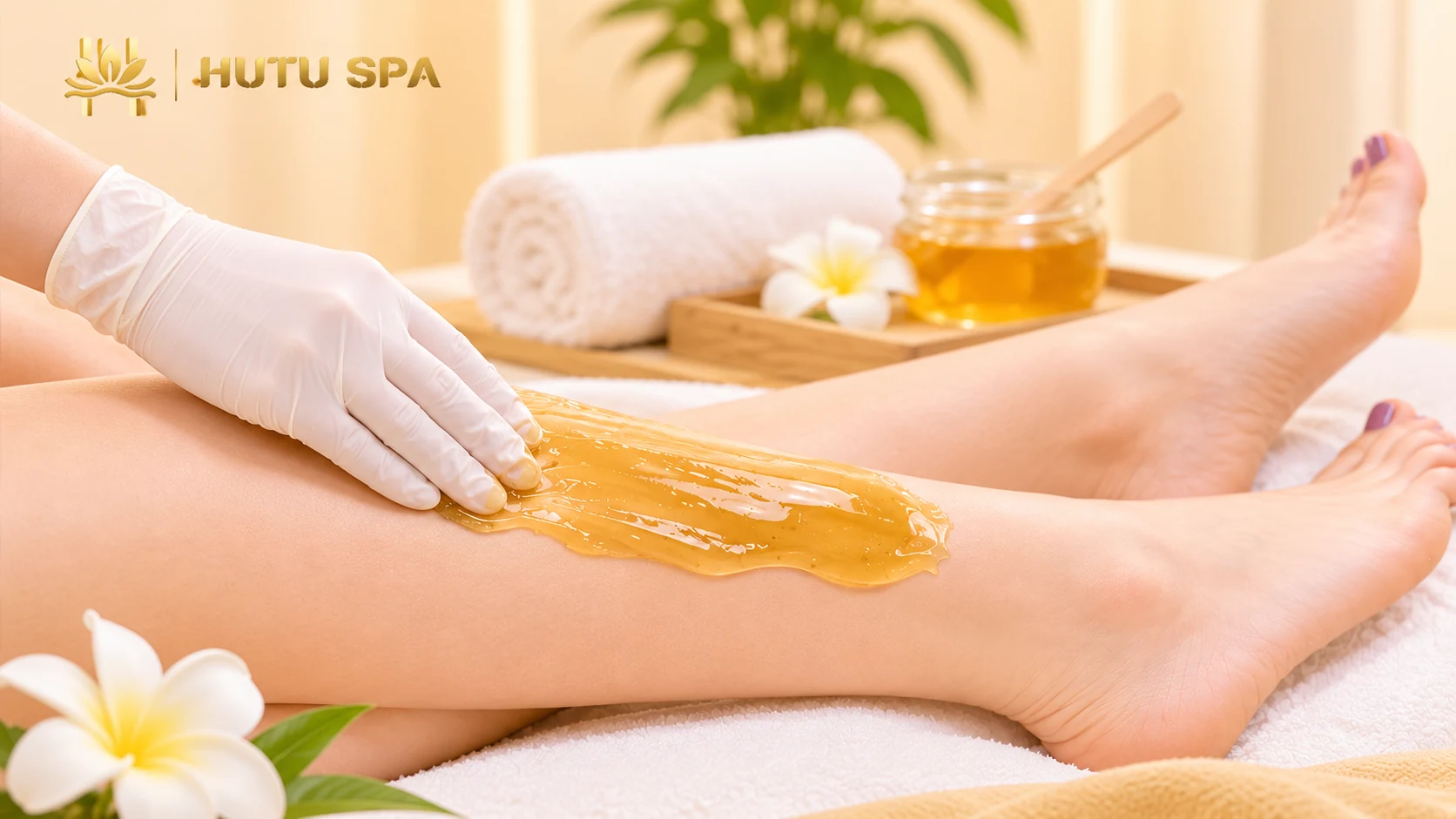
Leg waxing is a hair removal method that uses wax to pull hair out from the roots, leaving your legs smooth for approximately 3 to 4 weeks, much longer than shaving. However, you may experience a brief stinging sensation each time the wax is pulled off, and proper skincare during the first 48 hours is essential to prevent redness and folliculitis. This comprehensive guide brings together recommendations from the American Academy of Dermatology (AAD), DermNet, Cleveland Clinic, and the practical experience of Hutu Spa Nha Trang technicians. It explains the waxing process, pain levels, hair regrowth, and whether you should wax at home or visit a spa.
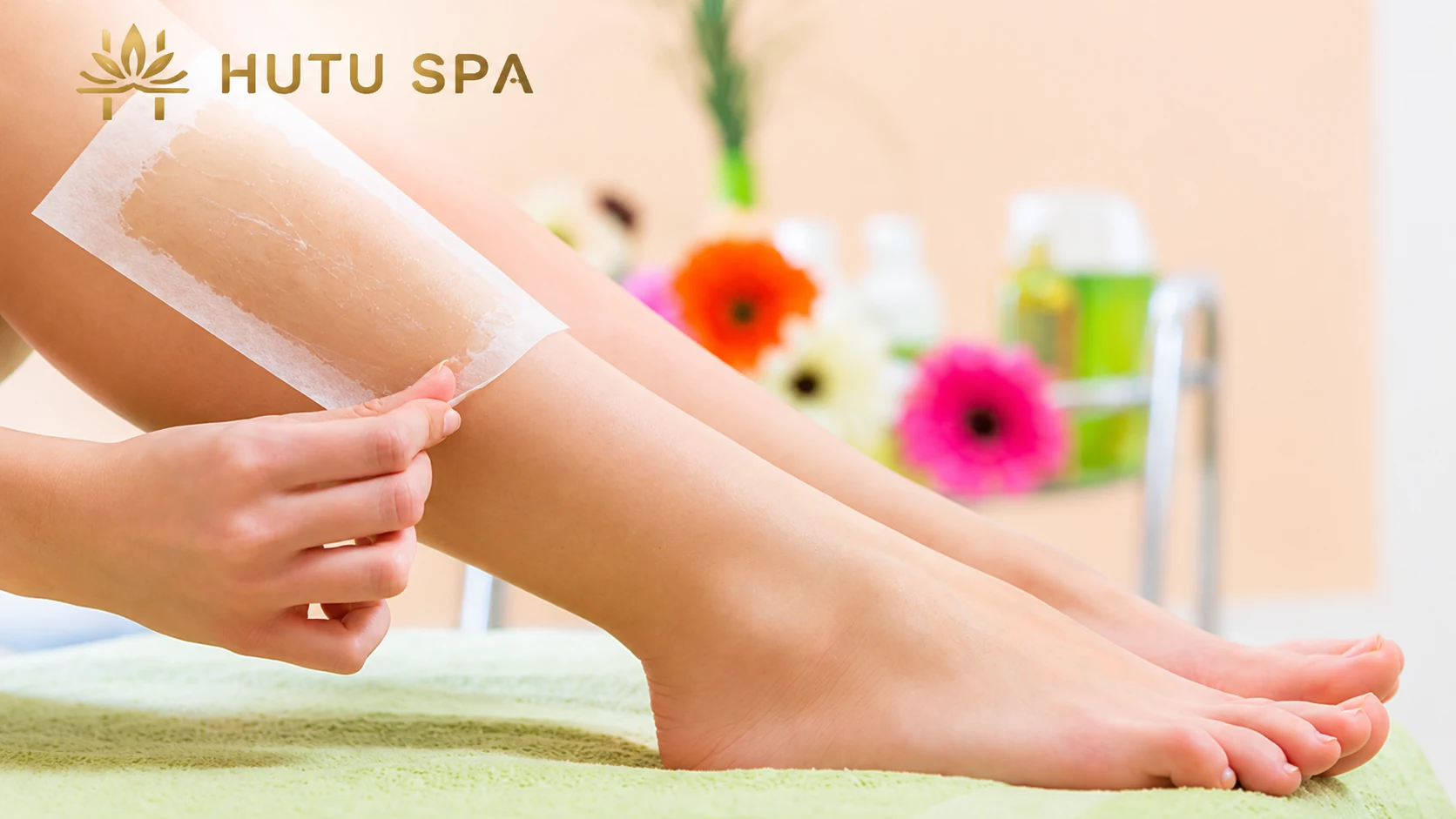
Quick summary of leg waxing
If you only have a minute, here are the most important things to know before getting your legs waxed:
- What is leg waxing: A temporary hair removal method that uses wax to remove the entire hair from the follicle rather than cutting it at the skin's surface like shaving.
- How long do the results last: Your skin can stay smooth for approximately 3 to 4 weeks, while new hair may start appearing after 2 to 3 weeks.
- Does it hurt: You may feel a brief, sharp sting when the wax is removed. Discomfort usually decreases after several regular waxing sessions. The knees, ankles, and inner thighs are more sensitive than the lower legs.
- How long should leg hair be before waxing: Approximately 0.6 cm or longer. If you normally shave, stop shaving about 2 to 3 weeks before your appointment.
- How often should you wax: Every 3 to 5 weeks. Avoid shaving between waxing sessions.
- When should you avoid waxing: Do not wax sunburned, scratched, or inflamed skin, or if you have taken isotretinoin within the past 6 months.
- Aftercare during the first 48 hours: Apply cool compresses, wear loose clothing, and avoid hot water, saunas, swimming, seawater, and strong sunlight.
- When to see a dermatologist: If redness or swelling lasts longer than 2 days, widespread pus-filled bumps develop, or pain becomes increasingly severe.
- At home or at a spa: Home waxing is suitable for people with experience and healthy skin. First-time waxing, sensitive skin, or thick, coarse hair are better handled by a professional spa.
What is leg waxing?
Leg waxing is a hair removal technique in which a layer of wax is applied to the skin so it can grip the hair. The wax is then pulled off quickly against the direction of hair growth, removing the entire hair from its follicle. According to DermNet, waxing is a form of epilation and is among the most effective temporary hair removal methods available. It can be used on large areas such as the legs as well as smaller areas such as the upper lip and chin.
How waxing removes hair from the root
When you shave, the razor only cuts the hair at the skin's surface. The hair underneath continues growing and may become visible again within 1 to 3 days. Waxing removes the hair shaft from beneath the skin's surface, so a new hair must grow from the beginning. This allows your legs to remain smooth for much longer.
Waxing also removes some dead skin cells from the surface. This is why your legs may feel smoother and look brighter immediately after a session. However, your skin can also become more sensitive for several hours. Waxing does not destroy hair follicles, so it is not a permanent hair removal treatment.
What is the difference between half-leg and full-leg waxing?
Spas commonly divide leg waxing into three service options to help customers choose according to their needs and budget:
| Waxing area | Coverage | Estimated time | Suitable for |
|---|---|---|---|
| Lower half legs | From below the knees to the ankles, including the shins and calves | Approximately 20 to 30 minutes | People who often wear skirts or cropped trousers and only need to remove visible leg hair |
| Upper half legs | The thigh area, with or without the knees | Approximately 20 to 30 minutes | People who wear shorts, swimwear, or workout clothing |
| Full legs | From the thighs to the ankles, usually including the knees and optionally the tops of the feet and toes | Approximately 45 to 60 minutes | People preparing for beach holidays, photoshoots, or sporting events |
The actual treatment time depends on hair thickness and the type of wax used. One detail many people do not know is that hair on the lower legs usually grows downward, while thigh hair may grow in several different directions. Experienced technicians divide the thighs into smaller sections and adjust the removal direction for each section to prevent hair breakage.
Common types of leg waxing products
For leg waxing, soft wax used with waxing strips is the most common choice because it is quick and covers large areas. Hard wax is more suitable for sensitive areas such as the knees and ankles. People often use the general terms hot wax, warm wax, and cold wax, but a more accurate way to distinguish waxing products is whether they require removal strips.
Soft wax
Soft wax is gently heated and spread in a thin layer in the direction of hair growth. A paper or fabric strip is then placed over the wax and pulled off. DermNet describes this as warm waxing, which is more effective than cold waxing and is commonly performed at spas. Soft wax also adheres to the skin, so repeatedly applying it to the same area should be avoided.
Hard wax (bead wax)
Hard wax is melted, applied in a thicker layer, and allowed to harden before being removed without a strip. It adheres more strongly to the hair than to the skin, making it suitable for short, coarse hair and thinner areas of the legs. Its main disadvantage is that it takes longer when treating large areas such as the thighs and calves.
Cold wax strips
Cold wax strips come with a pre-applied layer of wax. Simply rub the strip between your hands to warm it, apply it to the skin, and pull it off. This method is convenient for beginners or for touching up small areas at home. However, it may miss short hairs and often requires repeated removal in the same area.
| Wax type | How to use it | Suitable leg areas | Advantages | Things to consider |
|---|---|---|---|---|
| Soft wax | Warm the wax, apply a thin layer, place a strip over it, and pull | Shins, calves, and thighs | Fast and suitable for large areas | Adheres to the skin and may cause redness if repeatedly applied to the same area |
| Hard wax | Melt the wax, apply a thick layer, allow it to harden, and remove it | Knees, ankles, tops of the feet, and short, coarse hair | Pulls less on the skin and may cause less irritation | Slower for large areas and requires careful temperature control |
| Cold wax strips | Warm the strip between your hands, apply it, and pull | Touch-ups on small areas at home | Convenient and does not require a wax heater | May miss short hairs |
| Homemade sugar wax | Cook sugar, lemon, and honey into a thick mixture | Only recommended for testing on a small area | Inexpensive and made with readily available ingredients | Temperature is difficult to control and may cause burns |
DermNet notes that some people develop allergic contact dermatitis from rosin, an ingredient found in many waxing products. If you have a history of cosmetic allergies, check the wax ingredients and test the product on a small patch of skin first.

Benefits and limitations of leg waxing
Leg waxing is worth considering if you want smooth skin for several weeks at a reasonable cost. However, you need to accept brief discomfort during the treatment and allow your hair to grow long enough between sessions.
Practical benefits
- Longer-lasting smooth skin: According to Cleveland Clinic, one waxing session can keep your skin smooth for approximately 3 to 4 weeks, compared with only 1 to 3 days after shaving.
- No visible dark hair dots: Because the hair is removed from the root, you will not see the small dark dots that commonly remain after shaving.
- Softer regrowth: With regular waxing, new hair may become finer and softer, and the interval between sessions may gradually increase.
- Gentle exfoliation: Your legs may look brighter and feel smoother immediately after waxing because some dead skin cells are removed.
- No lengthy treatment course: Waxing can be done whenever needed, making it convenient before holidays, beach trips, or special events.
Limitations to consider
- Not permanent: Hair grows back because waxing does not destroy the hair follicles.
- Temporary pain and redness: DermNet explains that freshly waxed skin commonly becomes red and sensitive for several hours.
- Hair must grow long enough: You need to tolerate some visible stubble before your next waxing session.
- Risks from incorrect technique: Possible complications include ingrown hairs, folliculitis, wax burns, hyperpigmentation, and, more rarely, scarring.
Does leg waxing hurt?
Yes, but the discomfort is usually a brief, sharp sting lasting 1 to 2 seconds each time the wax is removed. It normally subsides quickly. Compared with thinner areas of skin that have more folds, the legs are generally more comfortable to wax because the skin is thicker, flatter, and the hair tends to grow more uniformly. Many customers who have previously experienced underarm waxing say that lower-leg waxing feels noticeably less uncomfortable, even during their first session.
Which areas of the legs hurt the most?
Pain levels are not the same across the entire leg. Areas with thinner skin, prominent bones, or skin folds tend to be more sensitive:
- Kneecaps and the backs of the knees: The skin is thinner, has several folds, and is more difficult to keep taut.
- Ankles and tops of the feet: These areas are close to the bones and have less soft tissue underneath.
- Inner thighs: The skin is thinner and more sensitive than on the outer thighs.
- Shins and calves: These areas are usually the least painful and are good starting points for beginners.
Besides the treatment area, discomfort may increase if you are waxing for the first time, have thick and coarse hair, have dry skin, feel tired or stressed, or are more sensitive in the days leading up to your menstrual period.

How to reduce pain during leg waxing
- Wax regularly: After several sessions, hair may become finer, making removal easier and less uncomfortable.
- Choose the right time: Avoid scheduling a session when you are extremely tired, sleep-deprived, or close to your menstrual period if you tend to be more sensitive during that time.
- Apply a cool compress before waxing: The AAD suggests using a cold compress or taking an over-the-counter pain reliever before waxing. If you have an underlying medical condition or are pregnant, consult a pharmacist before taking medication.
- Keep the skin taut and exhale as the wax is removed: Stretching the skin helps remove the hair completely and reduces unnecessary pulling.
- Apply gentle pressure immediately after removal: DermNet notes that gently pressing the freshly waxed area can help reduce discomfort.
- Speak up if you feel burning: Wax that is too hot can cause burns. A burning sensation is not a normal part of waxing.
How long does it take for leg hair to grow back after waxing?
Leg hair usually begins to reappear after 2 to 3 weeks (DermNet), while the skin can remain smooth for approximately 3 to 4 weeks (Cleveland Clinic). For some people, the results may last up to 6 weeks. This variation depends on individual hair growth patterns, hormones, hair thickness, and how regularly you wax.
The reason hair does not grow back all at once is related to the hair growth cycle. At any given time, some hair follicles are in a resting phase and have not yet pushed a hair above the skin. These hairs cannot be removed during the waxing session. They may emerge several days later, making it seem as though the hair has grown back quickly after your first treatment. After 3 to 4 regular waxing sessions, hair may grow more evenly, allowing the results to last longer.
How often should you wax your legs?
For most people, a suitable schedule is once every 3 to 5 weeks, when the hair has reached approximately 0.6 cm. The AAD recommends a hair length of around 0.6 to 1.9 cm for waxing. Shorter hair may not adhere properly to the wax, while longer hair should be trimmed to reduce discomfort.
Avoid shaving between waxing sessions. Shaving cuts the hair straight across, leaving blunt ends and hair strands of uneven lengths. This can make your next waxing session less effective and more uncomfortable. If you need a quick touch-up, you can use cold wax strips on a small area.

Does leg waxing make hair grow back thicker?
No. This is one of the most common misconceptions about leg waxing. The impression that hair becomes thicker and coarser usually occurs after shaving because the hair is cut flat across, making the ends feel rough to the touch. The number of hair follicles does not increase.
According to Cleveland Clinic, hair that grows back after repeated waxing often feels softer and appears finer. DermNet takes a more cautious position: the long-term effects of repeated waxing have not been clearly established, although repeated damage to hair follicles may reduce some hair growth. Therefore, consider reduced hair density a possible benefit rather than a guaranteed result.
Comparing leg waxing with shaving, hair removal creams, and laser hair removal
Waxing offers a balance between lasting results and cost. It keeps the skin smooth longer than shaving or hair removal creams, is generally less expensive and more flexible than laser hair removal, but is more painful during treatment than all three alternatives.
| Criteria | Waxing | Shaving | Hair removal cream | Hair removal treatment (laser, IPL) |
|---|---|---|---|---|
| How it works | Removes the entire hair from the follicle | Cuts hair at the skin's surface | Chemicals weaken and break down hair at the skin's surface | Light energy damages hair follicles |
| How long skin stays smooth | Approximately 3 to 4 weeks | Approximately 1 to 3 days | Several days to approximately 1 week | Long-term hair reduction after multiple sessions |
| Sensation | Brief, sharp discomfort | Painless | Painless, but may cause irritation or burning | A tingling or prickling sensation, depending on the device and treatment area |
| Common risks | Redness, ingrown hairs, and folliculitis | Cuts, ingrown hairs, and visible dark hair dots | Irritation and chemical burns if left on for too long | Burns and hyperpigmentation if incorrect settings are used |
| Where it is performed | At a spa or at home | At home | At home | At a qualified facility with appropriate equipment |
| Best suited for | People who want smooth skin for several weeks at a reasonable cost | People who need quick hair removal within minutes | People who dislike pain and have fine hair | People seeking long-term hair reduction who are willing to complete a treatment course |
If you currently shave and frequently experience ingrown hairs, switching to waxing may be a reasonable option to try before considering laser hair removal. If your goal is long-term, near-permanent hair reduction, laser treatment at a qualified medical facility may be more suitable. However, it requires multiple sessions and a higher initial investment.

Who should avoid leg waxing?
You should avoid leg waxing if your skin is damaged or if you are using medication that makes your skin thinner and more prone to tearing. Before your appointment, review the following checklist:
- You have taken isotretinoin (acne medication) within the past 6 months: The AAD advises against waxing. DermNet recommends a more cautious waiting period of 6 months to 1 year after stopping oral retinoids because of the risk of skin tearing and scarring.
- You are applying retinoids or retinol to your legs: DermNet recommends stopping these products approximately 3 to 4 weeks before waxing the treated area.
- Your skin is sunburned, scratched, has open wounds, or is inflamed: Wait until the skin has completely healed before waxing.
- You have an active flare-up of eczema, psoriasis, or a fungal skin infection on your legs: Waxing may make the condition worse.
- You have prominent varicose veins, raised moles, or warts: The technician should avoid these areas.
- You have diabetes, a blood clotting disorder, or take blood-thinning medication: Consult your doctor first because your skin may heal more slowly and bruise more easily.
- You are pregnant: Your skin may be more sensitive. Inform your technician and consult your doctor if you have varicose veins or pregnancy-related medical conditions.
- You have previously experienced an allergy to wax or rosin: Test the product on a small patch of skin and wait 24 hours.
- You have recently sunbathed, undergone a chemical peel, or had intensive exfoliation within the past 24 hours: Your outer skin layer may be weakened and more vulnerable to damage from waxing.
If you are unsure whether waxing is suitable for your condition, explain your concerns during the consultation. A spa that follows proper procedures will ask about these factors before starting and may refuse treatment if it considers waxing unsafe.
How to prepare for leg waxing
Proper preparation helps the wax grip the hair evenly, reduces discomfort, and lowers the risk of ingrown hairs. You can divide your preparation into three time periods:
2 to 3 weeks before your appointment
- Stop shaving and allow your hair to grow to approximately 0.6 cm. If it grows longer than 1.9 cm, trim it with small scissors.
- If you are taking acne medication or using topical products containing retinoids, consult your doctor about when it is safe to wax.
1 to 2 days before your appointment
- Gently exfoliate your legs. Cleveland Clinic suggests doing this 1 to 2 days before waxing to help prevent hairs from becoming trapped beneath dead skin cells. If your legs feel dry and rough after spending time at the beach, a full-body exfoliation treatment before your waxing appointment can help the wax grip the hair more evenly.
- Moisturize regularly. Well-hydrated skin helps hair come out completely and reduces the chance of breakage during removal.
- Avoid prolonged sun exposure. Do not schedule waxing if your skin is sunburned.
On the day of your appointment
- Shower and clean your legs, then dry them completely. The AAD emphasizes that clean, dry skin helps wax adhere properly.
- Do not apply moisturizer, oil, or sunscreen to your legs for several hours before waxing.
- Wear a skirt, shorts, or loose-fitting trousers to minimize friction against your skin afterward.
- Bring a list of your current medications and allergy history to inform your technician.

Professional leg waxing procedure at a spa
A professional leg waxing session at a spa typically consists of 7 steps. Waxing the lower half of the legs takes approximately 20 to 30 minutes. Understanding the process beforehand can help you feel more comfortable and recognize whether the spa is following essential safety procedures.
- Consultation and skin assessment. The technician asks about your current medications, allergy history, and checks for scratches, varicose veins, and appropriate hair length.
- Skin cleansing and disinfection. The skin is cleaned to remove dust and oil, then dried. Depending on the wax type, the technician may apply a thin layer of powder or pre-wax oil.
- Wax temperature testing. The wax should feel warm but must not cause pain or burns when tested on a small area of skin, in accordance with AAD recommendations.
- Applying wax in the direction of hair growth. The wax is spread over small sections using a wooden spatula. A new spatula should be used every time wax is taken from the pot. Used spatulas must never be dipped back into the wax.
- Applying the strip and pulling against hair growth. The strip is pressed firmly for approximately 2 to 3 seconds. One hand holds the skin taut while the other pulls the strip quickly, close and parallel to the skin.
- Soothing the skin and removing remaining hairs. The technician applies gentle pressure to the freshly waxed area and uses clean tweezers to remove any remaining hairs instead of repeatedly applying wax.
- Removing excess wax and moisturizing. Any remaining wax is removed with specialized oil, followed by a soothing gel and aftercare instructions.
Hygiene must never be overlooked. Guidelines from the New South Wales Department of Health (Australia) for waxing establishments require a new, single-use applicator for each customer to prevent cross-contamination. You have every right to observe and ask your technician about this practice.

How to wax your legs safely at home
Waxing your lower legs at home is relatively straightforward because the skin is flat, easy to see, and easier to keep taut. However, you should work slowly, follow the correct direction, and control the wax temperature carefully. Choosing between waxing at home or visiting a spa mainly depends on hair thickness, skin sensitivity, and your level of experience. For beginners, the thighs, knees, and backs of the legs can be more difficult because it is harder to keep the skin taut and pull the wax at the correct angle.
Tools and supplies you need
- Soft wax with waxing strips, or cold wax strips if you are a beginner.
- A wax heater with an adjustable temperature control and enough wooden spatulas for individual applications.
- Oil for removing excess wax, aloe vera gel, or a non-comedogenic moisturizer.
- Small scissors for trimming long hair, clean tweezers for removing remaining hairs, and clean towels.
Step-by-step instructions for waxing your legs
- Check the hair length and trim it if it is longer than approximately 1.9 cm.
- Shower, clean your legs, and dry them completely.
- Heat the wax according to the product instructions, then test it on your inner wrist. It should feel warm, never painfully hot.
- If you are using a new product for the first time, test it on a small patch of your lower leg and wait 24 hours.
- Apply a thin layer of wax in the direction of hair growth, working on one small section at a time. On the lower legs, hair usually grows from top to bottom.
- Place the waxing strip and press for 2 to 3 seconds. Hold the skin taut and pull quickly against the direction of hair growth, keeping the strip close to the skin.
- Apply gentle pressure to the freshly waxed area. Do not apply wax more than twice to the same spot. Use tweezers to remove any remaining hairs.
- Remove excess wax with oil, apply a cool compress if the skin is red or irritated, and moisturize.
Common mistakes when waxing your legs at home
- Wax that is too hot: One of the main causes of burns, blisters, and subsequent dark marks.
- Pulling slowly or pulling upward: May cause bruising, skin damage, and hair breakage beneath the skin.
- Repeatedly applying wax to the same spot: Can remove the outermost layer of skin, causing irritation and fluid leakage.
- Putting a used spatula back into the wax pot: This can introduce bacteria into the wax and contaminate future applications.
- Waxing skin that is still damp or covered with moisturizer: The wax will not adhere properly, requiring repeated applications.
- Using homemade lemon and sugar wax before going into the sun: Residual lemon juice on the skin may cause phytophotodermatitis when exposed to sunlight, potentially leaving dark marks. If you use this mixture, rinse it off thoroughly and avoid sun exposure.
How to care for your skin after leg waxing
The first 24 to 48 hours are when your skin is most vulnerable to irritation because the hair follicles remain open and some of the outer skin layer has been removed by the wax. Proper aftercare during this period plays a major role in preventing rashes, folliculitis, and dark marks.
During the first 24 to 48 hours
- Apply a cool compress for 10 to 15 minutes if your skin feels red or irritated.
- Wear loose, soft clothing to reduce friction, as recommended by the AAD.
- Avoid hot showers, saunas, hot tubs, swimming pools, and seawater.
- Avoid intense exercise that causes excessive sweating and prolonged exposure to strong sunlight. If you need to go outdoors, protect your skin with clothing.
- Do not use products containing alcohol, fragrance, AHA, BHA, or retinol on freshly waxed skin.
- Apply a lightweight moisturizer labeled "oil-free" or "non-comedogenic" to avoid clogging pores.
- Do not scratch your skin or rub it with rough towels.
From the third day onward
- Gently exfoliate 1 to 2 times per week to help prevent new hairs from becoming trapped beneath the skin.
- Moisturize daily after showering.
- Apply broad-spectrum sunscreen when going to the beach or spending extended periods outdoors.
- Avoid shaving between waxing sessions.
Regarding python oil: Some people claim that applying python oil after waxing slows hair regrowth, but there is currently insufficient scientific evidence to support this effect. If you want to try it, wait until the redness has disappeared and test it on a small patch of skin first.
When should you see a dermatologist? The AAD recommends seeking medical attention if redness or swelling lasts longer than 2 days. You should also consult a doctor if you develop multiple pus-filled bumps, spreading redness and swelling, increasing pain, fever, or blistering burns.
How to deal with ingrown hairs and folliculitis after waxing
Ingrown hairs occur when new hair becomes trapped beneath dead skin cells and curls back into the skin. This is more common in people with coarse, curly hair or dry skin. Folliculitis occurs when hair follicles become irritated or infected, creating small red bumps or pus-filled spots around the hair roots. Both are listed among the possible side effects of waxing by DermNet.
How to recognize the symptoms
- Small red bumps at the hair follicles that may feel itchy or painful when touched.
- Visible hair curled beneath the skin that cannot emerge normally.
- Small white-headed pustules around hair follicles, sometimes leaving dark marks.
How to manage the condition at home
- Do not squeeze the bumps or use needles or tweezers to dig out trapped hairs, as this can lead to infection and dark marks.
- Apply a warm compress for several minutes each day to soften the skin and help the hair emerge naturally.
- Gently exfoliate once the redness has subsided. Products containing low concentrations of salicylic acid may help keep hair follicles clear.
- Wear loose clothing and avoid tight trousers that rub against the inflamed area.
- Keep your skin clean and moisturize regularly.
If you develop multiple pus-filled bumps, spreading redness and swelling, increasing pain, or symptoms that persist for several days, consult a dermatologist rather than self-medicating. Post-inflammatory hyperpigmentation may also require professional guidance if the dark marks do not fade over time.
To prevent these problems from occurring, wax in the correct direction, remove the wax with a firm and decisive movement to prevent hair breakage beneath the skin, exfoliate regularly, and keep your skin adequately moisturized between sessions.
Leg waxing before a beach holiday in Nha Trang
You should wax your legs at least 24 to 48 hours before going into the sea. Ideally, schedule your session 2 to 3 days in advance. Seawater, sand, and strong sunlight in Nha Trang can all irritate freshly waxed skin, causing redness or darkening if you expose it too soon.
Suggested schedule for a 3 to 4-day trip
- 2 to 3 days before your flight: Get your legs waxed before traveling. You can enjoy the beach as soon as you arrive in Nha Trang.
- If you are already in Nha Trang: Schedule waxing in the late afternoon or evening on your first day. Spend the second day exploring indoor attractions or shaded areas, and go swimming from the third day onward.
- If you already have sunburn: Postpone waxing until the redness and peeling have completely disappeared.
How to keep your legs looking good during a beach holiday
- Apply broad-spectrum sunscreen after the first 48 hours and reapply after swimming.
- Rinse your skin with fresh water immediately after leaving the beach and gently pat it dry.
- Moisturize in the evening to prevent dryness and reduce the risk of ingrown hairs.
- If you want to combine waxing with a massage during the same visit, inform your technician in advance so they can arrange the correct treatment order and avoid vigorous rubbing or applying essential oils to freshly waxed skin.
What determines the price of leg waxing?
There is no single standard price for leg waxing because each spa may charge according to the treatment area, wax type, and appointment duration. Before booking, ask about the following factors so you can make a fair comparison:
- Waxing area: Whether you are booking lower half legs, upper half legs, or full legs, and whether the knees, tops of the feet, and toes are included.
- Hair thickness and length: Thick, coarse hair, which is more common among men, requires more wax and additional treatment time.
- Wax type: Hard wax and wax formulated for sensitive skin may cost more than standard soft wax.
- Supplies and hygiene: Single-use wooden spatulas, gloves, waxing strips, wax-removal oil, and soothing gel.
- Technician experience and treatment environment: Experienced technicians, private treatment rooms, and central locations may have different pricing from budget establishments.
- Packages and promotions: Waxing multiple areas or combining waxing with exfoliation or massage may offer better value than booking individual treatments.
A price that is significantly lower than the market average may indicate that the spa is cutting costs on disposable supplies. When asking for a quote, also confirm which areas are included, what type of wax is used, and whether additional charges apply to thick hair.
At Hutu Spa, waxing prices are quoted according to the treatment area after the technician has assessed your hair and skin condition. You can message the spa on Zalo or call 0396 161 183 to receive a price quote before your visit.
How to choose a reputable leg waxing spa
For a treatment involving heated wax and direct contact with hair follicles, hygiene and technical skill are more important than finding the lowest price. The AAD recommends checking whether salon technicians use wooden spatulas instead of metal applicators and whether they replace the spatula every time they take wax from the pot.
What to look for during your first appointment
- The technician asks about your current medications, allergies, and skin condition before starting.
- The technician wears gloves and disinfects your skin before applying wax.
- Wooden spatulas are single-use, and used spatulas are never dipped back into the wax pot.
- The wax temperature is tested before it is applied to your skin.
- Private treatment rooms, towels, and bed linens are changed after each customer.
- Clear post-waxing skincare instructions are provided.
- Recent Google Maps reviews include photos and genuine feedback from customers who have received waxing services.
These recommendations are part of the 12 criteria for choosing a reputable spa, which you can also apply when selecting other services, from massage to facial treatments.
Warning signs that you should consider going elsewhere
- The wax pot is left uncovered, or the wax contains visible hair or dirt. According to NSW Health, wax used on one customer must not be filtered or reheated for use on another customer.
- The same spatula is used throughout the entire session and repeatedly dipped into the wax pot.
- The technician does not ask about your health condition and immediately starts waxing.
- Wax is repeatedly applied to the same spot, causing the skin to become irritated or ooze fluid.
Leg waxing at Hutu Spa Nha Trang
Hutu Spa provides daily leg waxing services at 5 Hong Bang Street, Nha Trang Ward, Khanh Hoa, making it convenient for both local residents and travelers who need hair removal before visiting the beach. According to the spa's website, Hutu Spa has a Google rating of 4.9/5 from more than 1,745 reviews (November 2026 figures).
When you choose leg waxing at Hutu Spa, you will receive:
- A consultation and skin assessment before treatment, including questions about your current medications and allergy history.
- Waxing in a private treatment room, with remaining hairs removed using clean tweezers.
- Post-waxing skincare instructions, especially if you are planning to go swimming or visit the beach.
- Communication in Vietnamese, English, Korean, Russian, and Chinese.
When booking waxing services at Hutu Spa Nha Trang, simply tell the team which area you want waxed (lower half legs, upper half legs, or full legs), your current hair length, and your planned beach date. The technician can then arrange a suitable appointment.
How to book an appointment
- Call or message the spa via Zalo, WhatsApp, KakaoTalk, or WeChat at 0396 161 183, or book through the website.
- Tell the team which area you want waxed, your skin condition, and any medications you are taking. Men with thick leg hair should mention this in advance so the spa can allocate enough time.
- Arrive approximately 10 minutes early and wear a skirt or loose-fitting trousers.
Frequently asked questions about leg waxing
How long does leg waxing take?
Waxing the lower half of the legs usually takes approximately 20 to 30 minutes, while full-leg waxing takes around 45 to 60 minutes. Thick hair or a first-time appointment may take slightly longer.
How long should leg hair be before waxing?
Leg hair should be at least approximately 0.6 cm long. The AAD recommends a length between 0.6 and 1.9 cm. If you normally shave, stop shaving around 2 to 3 weeks before your waxing appointment.
Should I shave between waxing sessions?
No. Shaving makes hair lengths uneven and leaves blunt ends, which can make your next waxing session less effective, more painful, and more likely to result in ingrown hairs.
Does leg waxing cause dark marks?
Waxing performed with the correct technique and followed by proper aftercare generally does not cause dark marks. Hyperpigmentation is more likely to occur after inflammation, wax burns, repeated application to the same area, or scratching and squeezing ingrown hairs.
Should men get their legs waxed?
Yes, if you want smoother legs for sports, swimming, cycling, or simply prefer the feeling of hair-free skin. Men's leg hair is often thicker and coarser, so the first session may be more uncomfortable. Trimming the hair beforehand and visiting a professional spa are recommended.
How soon can I shower after leg waxing?
You can take a cool or lukewarm shower after a few hours. During the first 24 to 48 hours, avoid hot water, saunas, swimming pools, seawater, and body washes with strong fragrances.
Does leg waxing make pores larger?
Waxing does not permanently enlarge pores. Immediately after treatment, hair follicles may appear slightly red or raised, but this usually settles within several hours to one or two days.
Can pregnant women wax their legs?
Many pregnant women can still have their legs waxed if their skin is healthy. However, skin is often more sensitive during pregnancy. Inform your technician and consult your doctor if you have varicose veins, gestational diabetes, or other medical conditions.
How long does it take for leg hair to become thinner after waxing?
After several months of regular waxing, many people notice that regrowing hair feels finer and softer. Results vary depending on individual hair growth patterns, and this is not a permanent effect.
Conclusion
Leg waxing is a simple way to enjoy smooth legs for 3 to 4 weeks, provided you allow your hair to grow long enough, choose the right type of wax, and follow proper skincare during the first 48 hours. If you have experience and only need to wax your lower legs, doing it at home is entirely possible. However, if this is your first session, you have thick, coarse hair, or you need your thighs and knees waxed before a beach holiday, a professional spa session can be faster, more thorough, and less risky.
Are you currently in Nha Trang or planning to visit soon? Message Hutu Spa via Zalo at 0396 161 183 for advice on the right waxing area and to arrange an appointment that fits your beach schedule.
Written by the Hutu Spa Editorial Team, updated November 2026. This article is for informational purposes only and does not replace professional advice from a dermatologist.